
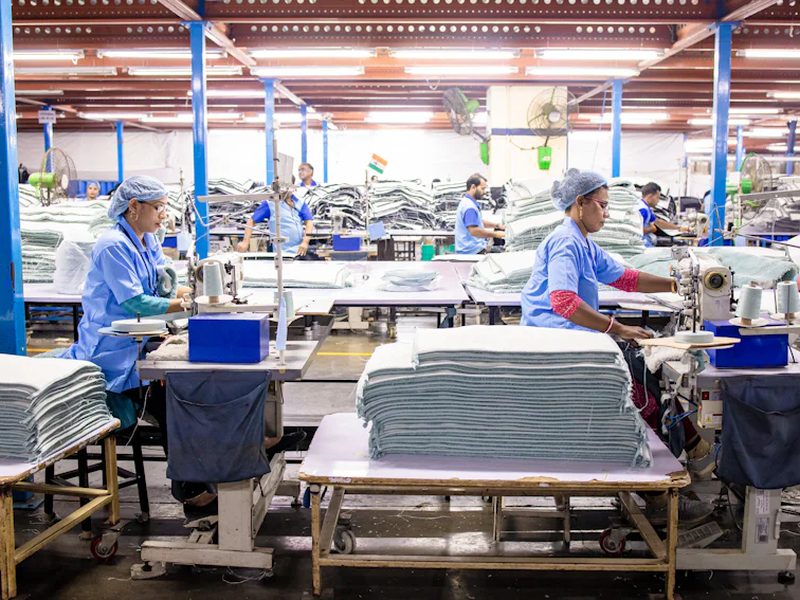
A brand founder based in Toronto reached out to us after spending six months working with a factory that bought pre-made blanks and screen printed them — not what she had asked for. Her tech pack called for custom cut panels, a specific French terry weight, and a drop-shoulder silhouette. What she received looked nothing like her samples. The factory had never done true cut and sew work. The distinction matters more than most first-time buyers realize.
Cut and sew manufacturing means the factory starts from raw fabric — cutting panels to your exact pattern and sewing them together to your specification. No pre-made blanks, no shortcuts. Every seam, measurement, and construction detail comes from your tech pack. For brands that need a specific fit, proprietary silhouette, or technical construction, it’s the only model that works.
Table of Contents
- Polo Shirt Manufacturer: OEM Sourcing Guide for Brand Founders
- What Cut and Sew Manufacturing Actually Means
- Cut and Sew vs. Blank Apparel: Which Do You Need?
- The Cut and Sew Production Process, Step by Step
- What to Prepare Before Contacting a Cut and Sew Manufacturer
- Mistakes Brands Make When Working With Cut and Sew Factories
- How to Evaluate a Cut and Sew Manufacturer Before Committing
- What PRP Apparel Produces via Cut and Sew
- Summary: Cut and Sew at a Glance
- FAQ
What Cut and Sew Manufacturing Actually Means
Cut and sew is the standard production method for custom garments. A roll of fabric comes into the factory, gets spread across a cutting table, and panels are cut to your pattern specs. Those panels are then sewn together by operators following your construction sheet — stitch type, seam allowance, topstitch placement, everything.
The term gets misused often. Some suppliers describe themselves as cut and sew manufacturers but are actually sourcing pre-cut blanks from a third party and doing finishing work only. A real cut and sew factory controls the full process: fabric sourcing, spreading, cutting, sewing, finishing, and QC. When you’re evaluating a factory, ask to see their cutting room. If they don’t have one, they’re not doing cut and sew.
Cut and Sew vs. Blank Apparel: Which Do You Need?
Blanks are pre-made garments — a white T-shirt in a standard fit that you add your branding to via print or embroidery. They’re fast and cheap to source. They work for merch, uniform programs, or brands that don’t care about differentiating their silhouette.
Cut and sew is for brands that need something specific: a hoodie with a longer body length, a jogger with a specific waistband construction, a jacket with custom pocket placement. You control the pattern, the fit, and the fabric weight. The tradeoff is higher development cost (you’re paying for sampling and pattern-making) and a longer lead time to first production.
Most serious clothing brands — ones building a recognizable product aesthetic — move to cut and sew by their second or third collection. The fit becomes part of the brand identity, and blanks can’t replicate it.
The Cut and Sew Production Process, Step by Step
Step 1: Fabric Sourcing and Confirmation
You specify fiber content, GSM, construction (jersey, French terry, ripstop, etc.), and any certifications. The factory pulls swatches from their mill network — in Dongguan, most factories have relationships with Guangdong and Zhejiang mills that cover a full range of knit and woven fabrics. You approve the swatch before cutting begins.
Step 2: Pattern Making and Grading
Your tech pack is translated into a production pattern. If you’re ordering multiple sizes, the factory grades the pattern across your size run — scaling the measurements proportionally from your base size. Errors at this stage show up in fit, so this is where detailed tech packs with POM (points of measure) tables matter most.
Step 3: Sample Production
A sew-by sample is produced before bulk cutting. This is your proof-of-concept. Check fit, construction quality, label placement, and finishes. Most brands take 1–2 rounds of sample revisions before approving for bulk. At PRP, sample lead time runs 7–14 business days from tech pack receipt.
Step 4: Bulk Fabric Cutting
Once you approve the sample, fabric is ordered in bulk and spread on the cutting table in multiple layers. Panels are cut using die cutters or computerized cutting machines depending on the factory’s setup. Marker efficiency — how well panels nest together with minimal waste — directly affects your per-unit fabric cost.
Step 5: Assembly and Sewing
Cut panels move to the sewing line. Operators assemble garments in a sequence — typically front and back panels first, then sleeves, collar, and finishing details. Quality operators maintain consistent seam tension and stitch counts. A factory with high turnover in its sewing floor produces inconsistent quality across a bulk order.
Step 6: Finishing, Labeling, and QC
Completed garments go through finishing: thread trimming, pressing, and inspection. Labels — woven, care, size — are attached to your specification. A final QC check pulls a sample from the bulk run and measures against your approved sample. Reputable cut and sew manufacturers flag any units outside tolerance before packing.
Step 7: Packaging and Shipment
Garments are folded, bagged in polybags, and packed into export cartons. Packing list and commercial invoice are prepared for customs. Most factories in Dongguan ship via Guangzhou or Shenzhen port for sea freight, or Guangzhou Baiyun Airport for air.
What to Prepare Before Contacting a Cut and Sew Manufacturer
Walking into a factory conversation without preparation guarantees a slow, expensive process. Have these ready before you make contact:
A Complete Tech Pack
This is non-negotiable for cut and sew. Your tech pack should include flat sketches (front, back, detail views), a points of measure table for each size, fabric specification, construction notes, label placement diagram, and colorway details with Pantone references. A tech pack without measurements is just a sketch — the factory can’t quote or pattern-make from it.
Target Fabric Spec
Specify fiber content, weight in GSM, and construction. If you have a reference fabric, send a physical swatch — factories match to swatches faster and more accurately than written descriptions. If you’re flexible on exact GSM, give a range (e.g., 280–320gsm) so the factory can work from available mill stock.
Size Run and Quantity
Know your total order quantity per style and how that quantity breaks across sizes. MOQ at most cut and sew manufacturers in China starts at 100–300 pieces per style for standard constructions. PRP Apparel’s cut and sew MOQ starts at 50 pieces — lower than most because the factory controls its own production floor rather than outsourcing.
Delivery Target
Work backwards from your launch date. Sample approval typically takes 2–4 weeks including revisions. Bulk production runs 25–40 days after sample approval. Add 2–4 weeks for sea freight to the US, UK, or Australia. A realistic timeline from first contact to goods-in-hand is 10–14 weeks for a new style.
Mistakes Brands Make When Working With Cut and Sew Factories
Approving a Sample That Doesn’t Fit Your Spec
Buyers sometimes approve samples to move production forward, assuming issues will be corrected in bulk. They won’t be. Bulk is cut and sewn to the approved sample, not to your original tech pack. If the sample’s shoulder seam sits 2cm off, every unit in your bulk order will have the same problem. Push back on samples that aren’t right.
Not Specifying Fabric Before Sampling
If you let the factory choose fabric for sampling without your input, the sample comes back in whatever was available. You approve the fit, go to bulk — and discover the bulk fabric is a different weight or feel because the sample fabric was one-off mill stock. Always confirm the exact fabric, GSM, and composition before sampling begins, and ensure the same fabric is used for bulk.
Underestimating Lead Time
New brands routinely assume cut and sew production takes 3–4 weeks. It doesn’t. A new style with no prior sampling history needs 2–3 rounds of sampling before it’s production-ready. Plan for 12–16 weeks from first contact to delivery for your first order with a new factory. Repeat orders on approved styles can move faster — 6–8 weeks from order confirmation.
Choosing Price Over Production Capability
A factory quoting 30% below market is either cutting corners on materials, subcontracting to a third party, or both. Cut and sew quality depends on the skill of the operators and the condition of the machines on the sewing floor. Before committing, ask for photos or a video call showing the factory floor. A legitimate cut and sew manufacturer won’t hesitate.
How to Evaluate a Cut and Sew Manufacturer Before Committing
Four questions that filter out the wrong factories quickly:
Do they have their own cutting room? Ask for a photo. A factory without cutting capability is a middleman, not a cut and sew manufacturer.
Can they show you production samples in your product category? A factory producing hoodies and a factory producing technical outerwear have different equipment and operator skill sets. Ask for samples in the specific category you’re ordering, not generic portfolio pieces.
What is their actual MOQ? MOQ affects your flexibility. A factory requiring 500 pieces minimum per style limits your ability to test new products without significant inventory risk. Factories with lower MOQ — like PRP’s 50-piece minimum — give you room to test before scaling.
How do they handle QC? Ask specifically: who does the final inspection, and what happens to units that fail? The answer tells you whether quality control is built into their process or treated as an afterthought.
What PRP Apparel Produces via Cut and Sew
PRP Apparel is a cut and sew manufacturer based in Dongguan, Guangdong, producing across six categories with a minimum order quantity of 50 pieces per style.
Tops include T-shirts, hoodies, sweatshirts, polo shirts, and long-sleeve styles in cotton, French terry, and technical knit fabrics. All cut from raw fabric to your pattern, not sourced as blanks.
Activewear covers sports bras, compression leggings, tracksuits, and performance tops in polyester-spandex constructions. Four-way stretch fabrics, flatlock seaming, and sublimation printing are all in-house capabilities.
Outerwear includes bomber jackets, parkas, windbreakers, and padded jackets. Shell fabrics — nylon ripstop, taslan, woven polyester — are sourced from Guangdong mills with DWR coating available.
Bottoms, dresses, and lingerie and sleepwear round out the category range. Custom woven labels, care labels, hang tags, and packaging are handled in-house as part of every production order.
Summary: Cut and Sew at a Glance
| Factor | Cut and Sew | Blank + Print |
|---|---|---|
| Silhouette control | Full — your pattern | None — factory standard |
| Fabric choice | Any spec you define | Limited to blank stock |
| MOQ (PRP) | From 50 pieces | From 1 piece (blanks) |
| Sample lead time | 7–14 business days | 3–5 business days |
| Bulk lead time | 25–40 days | 7–14 days |
| Brand differentiation | High | Low |
| Unit cost | Higher at low MOQ | Lower at any volume |
| Best for | Brands building a product identity | Merch, uniforms, quick drops |
External Resources
- ISO 13688 — Protective Clothing General Requirements — relevant for brands producing workwear or technical apparel via cut and sew
- OEKO-TEX Standard 100 — fabric certification commonly requested for cut and sew production targeting EU and US markets
FAQ
Q: What is the difference between cut and sew and private label manufacturing?
A: Cut and sew describes the production method — raw fabric is cut to your pattern and sewn to your spec. Private label describes the business model — you sell the finished product under your own brand. Most private label clothing is produced via cut and sew, but not all cut and sew work is private label. A brand can use cut and sew for white-label products sold to other businesses without ever putting their own label on the garment.
Q: What is the minimum order for cut and sew manufacturing at PRP Apparel?
A: PRP’s minimum order quantity for cut and sew production starts at 50 pieces per style. This applies across product categories including tops, bottoms, outerwear, and activewear. The low MOQ is possible because PRP operates its own factory floor rather than subcontracting to outside facilities.
Q: Do I need a tech pack to start cut and sew production?
A: Yes. Cut and sew production cannot begin without a tech pack that includes pattern measurements, construction notes, and fabric specification. A sketch or mood board alone is not enough. If you don’t have a formal tech pack, PRP can help develop one during the sampling stage — but the process takes longer and the first sample serves partly as a tech pack development exercise.
Q: How long does cut and sew sampling take?
A: At PRP, initial sample production runs 7–14 business days from the date your tech pack and fabric selection are confirmed. Most brands require 1–2 rounds of revisions before approving for bulk. Budget 3–5 weeks for sampling including revisions, then 25–40 days for bulk production.
Q: Can cut and sew manufacturers in China handle small orders?
A: Most factories in China require 200–500 pieces minimum per style for cut and sew because the setup cost — pattern making, fabric cutting, line setup — needs to be spread across enough units to be economical. Factories with lower MOQs, like PRP at 50 pieces, run smaller batches efficiently by owning their production capacity rather than competing for line time on a shared floor.
Q: What fabrics are available for cut and sew production in Dongguan?
A: Dongguan factories have access to a wide range through Guangdong and Zhejiang mill networks: cotton jersey, French terry, fleece, polyester interlock, nylon ripstop, denim, linen, Tencel, and polyester-spandex performance fabrics. OEKO-TEX certified and organic options are available at slightly higher cost and with longer lead times for fabric procurement.
Q: What should I look for in a cut and sew factory audit?
A: Focus on three things: the cutting room (should have industrial spreading and cutting equipment, not hand scissors), the sewing line (consistent machine types, clean and well-maintained), and the QC station (dedicated inspection area, not just a table at the end of the line). Ask to see current production in progress, not just a showroom of finished samples.
Q: How do I get an accurate price quote for cut and sew manufacturing?
A: A factory needs four pieces of information to quote accurately: your tech pack with measurements, target fabric spec, order quantity by size, and delivery timeline. Quotes based on incomplete information will change — sometimes significantly — once production starts. Send a complete brief and ask for a detailed breakdown of fabric cost, CMT (cut, make, trim), and any additional charges for labels and packaging.
Send your tech pack and quantity to PRP Apparel via WhatsApp at +8615899926902 and get a quote back within 24 hours — include your style, fabric preference, and target quantity, and we’ll confirm pricing and sample lead time by return. Or fill in the request form at prpapparel.com/contact and the team picks it up the same day.
Related Reading
- Mastering Cut & Sew Manufacturing for Unique Apparel Designs
- Fabric Types and GSM: What Clothing Brands Need to Know When Selecting Materials for Manufacturing
- How to Choose the Best Underwear Manufacturer for Your Brand in 2025
- Explore All Our Manufacturing Services
Related Manufacturing Services
Ready to Start Your Clothing Project?
- MOQ from 50 pieces per style
- OEM and private label production
- Sample development support
- Fabric sourcing
- Quality inspection before shipment
- Worldwide shipping support