
Decorating Polyester and Poly Blends: What Holds, What Melts, What Drops Out
Polyester is thermoplastic. Heat is what makes a pleat permanent and a laser edge seal shut on it — and heat is also what glazes an ultralight polyester under a patch press. Prophesy Apparel (PRP) decorates polyester in-house and through our production network; this page is the short list of which embellishments the fibre rewards, which it punishes, and where a poly-cotton blend changes the answer.
Laser cutting format
in-house, edges seal on polyester
Pleat holds below
drops out above 60°C or in a hot dryer
MOQ, per style per colour
same minimum on decorated polyester
Sample lead time
bulk 25–45 days after approval
Why Polyester Takes Some Decoration So Well
Polyester softens and re-sets under heat. Cotton, linen and viscose do not — they scorch or simply relax back to flat. Almost every decoration decision on a polyester garment comes back to that one property.
Pleats become permanent. Heat-set into 100% polyester, a knife, box or accordion pleat survives repeated washing below 40°C. The same pleat pressed into cotton collapses on the first wash, which is why our pleating and smocking work, run through our production network, is quoted on polyester, acetate and nylon rather than cotton.
Laser-cut edges seal. On polyester, polyester mesh and scuba-style air-layer fabric the beam melts the fibre at the cut line and the edge fuses as it cools — no fray, no binding. We run laser cutting in-house on a 3-metre-format machine, so a full dress front or a long coat panel can be cut in one piece.
The same property is the risk. A 3D silicone patch is pressed at roughly 150–170°C for 10–15 seconds. Ultralight polyester glazes or melts under that; those styles get the sew-on version of the patch instead.
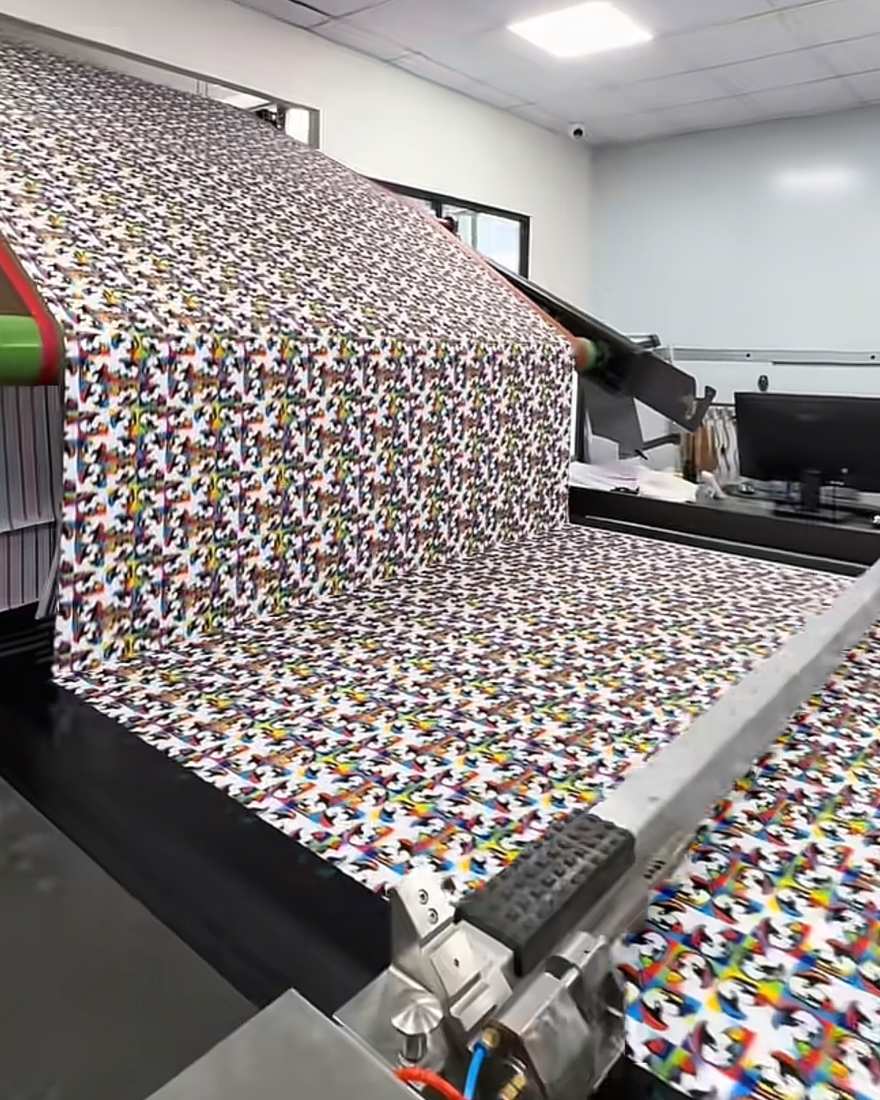
Printed fabric coming off a rotary heat press — heat and pressure are the working tools on polyester, for print and for pleat alike.
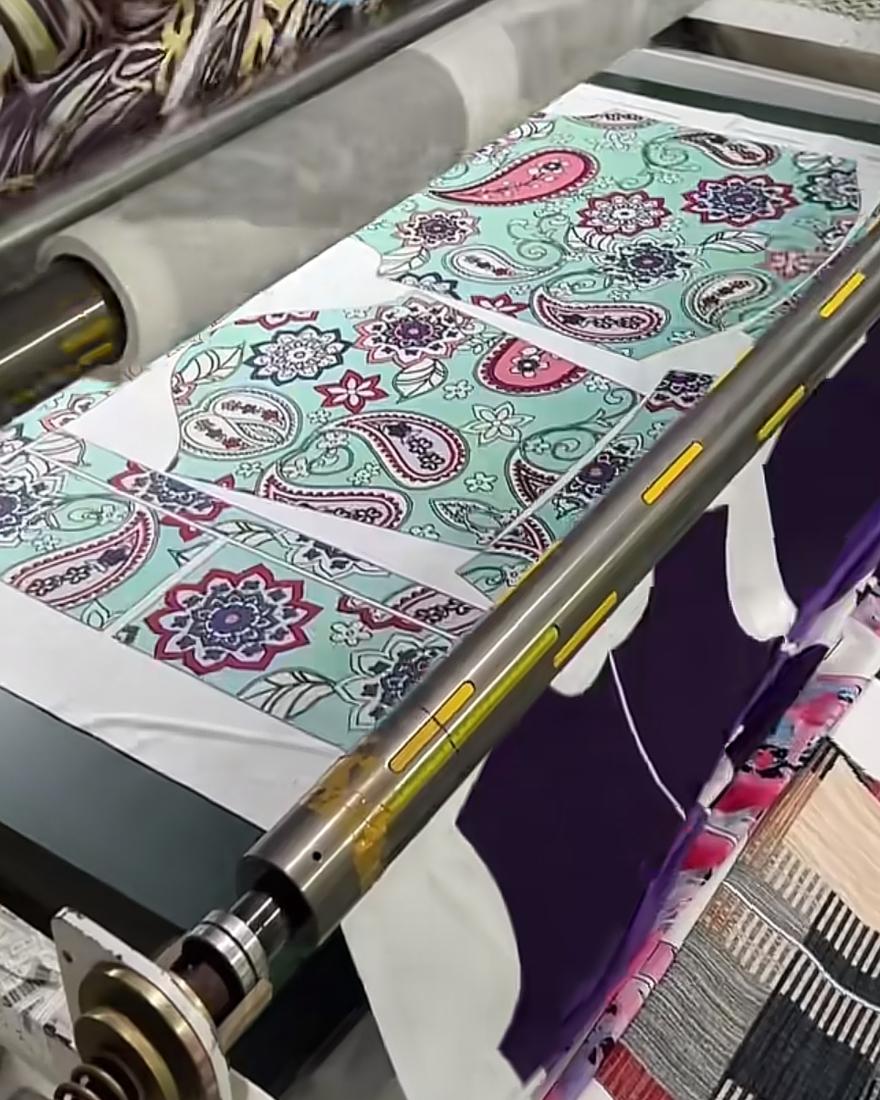
Cut panels going through a heat transfer calender. Panel-by-panel work like this is where an ultralight fabric shows heat damage first.
Polyester Decoration Specifications
| Brand | Prophesy Apparel (PRP) |
| Founded | 2015 |
| MOQ | 50 pieces per style, per colour |
| Sample lead time | 7–14 days |
| Bulk lead time | 25–45 days from approved sample |
| Laser cutting | In-house, 3-metre format. Polyester edges self-seal. Minimum hole about 0.5–1mm; connecting bridges under 1.5mm burn through |
| Heat-set pleating | Partner facility. Permanent on 100% polyester below 40°C wash; drops out above 60°C or in a hot tumble dryer. Fabrics over 200gsm will not take a crisp pleat |
| Pleating fabric use | 2.5–3× the flat yardage (accordion about 2.5–3×, knife pleat about 3×) |
| 3D silicone patches | Partner facility. Heat press about 150–170°C for 10–15 seconds; sew-on version for ultralight polyester. Mould fee USD 40–100 one-time per style |
| Hand beading | Partner workshop. Woven polyester needs about 80–100gsm or more to carry the weight; knits must be interlined |
| Embroidery | In-house, 24 heads. Ultralight polyester needs backing; high-stretch knits need cut-away backing. Digitizing fee USD 40–100 one-time per style |
| Not accepted | PVC or PVC-coated trims for laser cutting |
| Not offered | Scrubs / medical wear |
When Polyester Is the Wrong Base for the Decoration
Polyester is not automatically the right answer just because it pleats and laser-cuts well. These are the cases where we push back before sampling:
The garment will be washed hot or tumble dried. A heat-set pleat is permanent only below the temperature that set it. Workwear that goes through 60°C laundry, or anything likely to meet a hot dryer, loses its pleats. A stitched treatment — shirring or smocking — survives that laundry where a heat-set pleat does not.
The fabric is heavy. Over 200gsm, polyester will not take a crisp pleat. Heavier scuba or neoprene can still be laser-cut, but should not be pleated.
The fabric is ultralight and the design calls for a pressed patch. At 150–170°C an ultralight polyester glazes or melts around the patch. Either the patch becomes sew-on, or the base fabric gets heavier.
Heavy hand beading on chiffon or georgette. Polyester chiffon can be beaded, but it sags and distorts under the weight. Woven bases under about 80–100gsm are the wrong home for dense beading; high-stretch polyester knits are worse, because beading kills the stretch and the threads snap.
The trim is PVC. Some “poly” trims are PVC-coated. Laser-cutting PVC releases chlorine gas, so we will not run it, regardless of quantity.
Polyester vs Poly-Cotton vs Cotton: Which Decoration Works on Which
The same technique gives three different results on three common bases. Where a cell says “judged at sampling”, there is no single rule we would put in writing — the cotton share of a blend decides it.
| Technique | 100% polyester | 65/35 poly-cotton | 100% cotton |
|---|---|---|---|
| Heat-set pleating | Permanent; wash below 40°C | Softens after roughly 10–20 washes | Collapses on first wash — shir or smock instead |
| Laser-cut visible edge | Self-seals, no fray | Judged at sampling | Scorches brown; hidden or bound edges only |
| Shirring / smocking (stitched) | Works | Works | Works — held by stitching, not heat |
| 3D silicone patch, heat-pressed | Works on mid and heavy weights; ultralight glazes | Works | Works |
| Hand beading | Needs woven ≥80–100gsm; no high-stretch | Needs woven ≥80–100gsm | Needs woven ≥80–100gsm |
| Multi-head embroidery | Backing on ultralight; cut-away on stretch knits | Works | Works |
Poly-Cotton Blends: Where the Rules Change
A blend is not half-polyester in behaviour. The cotton share sets a ceiling on everything that relies on heat.
Pleats. A 65/35 poly-cotton holds a heat-set pleat at first, then softens after roughly 10–20 washes. If the pleat is the point of the garment, it belongs on 100% polyester. If the cotton hand matters more, smocking or shirring holds the shape with stitches and does not care about fibre content. Our note on why pleats fall out of cotton covers the physics in more detail.
Laser cutting. Pure synthetics seal and pure naturals scorch; blends sit between the two. We do not promise a sealed edge on a blend from a fabric name — we cut the actual fabric at the sample stage (7–14 days) and decide from the edge. The longer answer is in can you laser cut cotton fabric.
Cost. Pleating consumes 2.5–3× the flat yardage, so on a pleated style the fabric choice moves the price more than the labour does. That is worth checking before choosing a premium polyester for a fully pleated skirt.
For the full list of fabrics we cut and sew, from cotton jersey to nylon blends, see our materials overview. For every decoration technique in one place, see the embellishment hub.
Feel a Pleated Polyester Panel Before You Order
A crisp polyester pleat, a sealed laser edge and a pressed silicone patch all flatten into the same thing in a product photo. Request our embellishment swatch card and we will send real samples of pleating, laser cutting, silicone patches, beading and specialty embroidery. It is free to make; shipping is paid by you, and we will confirm the cost before anything ships.
Polyester Decoration Questions Buyers Actually Ask
Can polyester be pleated permanently?
Yes. Polyester is thermoplastic, so a heat-set pleat on 100% polyester is permanent and survives repeated washing below 40°C. Above 60°C, or in a hot tumble dryer, the pleat drops out.
Does laser cutting seal polyester edges?
Yes. The beam melts the fibre at the cut line and the edge fuses as it cools, so polyester, polyester mesh and scuba-style fabric do not fray. PRP runs laser cutting in-house on a 3-metre format, with a minimum hole of about 0.5–1mm.
Do pleats last on a 65/35 poly-cotton blend?
Not as long. A 65/35 poly-cotton holds a heat-set pleat at first but softens after roughly 10–20 washes. For a pleat that has to last, use 100% polyester, or switch to stitched smocking or shirring on the blend.
Can a silicone patch be heat-pressed onto lightweight polyester?
Not onto ultralight polyester. The press runs at about 150–170°C for 10–15 seconds, which glazes or melts very light polyester. Those styles get the sew-on version of the patch.
Why does a pleated polyester skirt cost more than a flat one?
Mostly fabric, not labour. Pleating consumes 2.5–3× the flat yardage — about 2.5–3× for accordion pleats and about 3× for knife pleats — so the fabric price is multiplied before any decoration is added.
What is the minimum order for decorated polyester garments?
50 pieces per style, per colour, so three colourways of one style means 150 pieces. Most factories that handle heavy embellishment want 300+ pieces. We start at 50.
Send Us the Fabric and the Decoration
Tell us the fabric composition, the weight, the decoration and the quantity. If the base fabric will not hold what the design needs — a pleat on cotton, a pressed patch on ultralight polyester — we will say so before a sample round, not after. Email works too: tkandyyu01@gmail.com.