
Hand Beading, Hotfix Rhinestone & Sequin Embroidery for Garment Manufacturing
Prophesy Apparel (PRP) treats hand beading, hotfix rhinestone application, and sequin embroidery as three separate embellishment techniques — not one interchangeable “bling” category. Each uses different equipment, a different attachment method, and survives washing differently. Brands come to us for this work on dresses, eveningwear, and small-batch decorative pieces where the bead or crystal placement has to hold up under real handling, not just look good in a product photo.
MOQ, per style per colour
50 pcs
same minimum across all six embellishment techniques
Sample lead time
7–14 days
25–45 days to bulk
Spare-bead packs
Provided
shipped with heavily beaded styles as standard
Attribution
Three sources
hand beading & hotfix rhinestone via partner network; sequin embroidery in-house
What Hand Beading, Hotfix Rhinestone and Sequin Embroidery Actually Are
Hand beading is exactly what it sounds like — a worker manually stitches individual beads, sequins, or stones onto the garment with a needle and thread, one at a time or in small clusters. It is the slowest and strongest of the three: hand-sewn beading survives being caught, pulled, and worn against skin better than anything glued or heat-pressed, because every bead is individually anchored to the fabric. It runs through a partner workshop we coordinate directly, not our own floor.
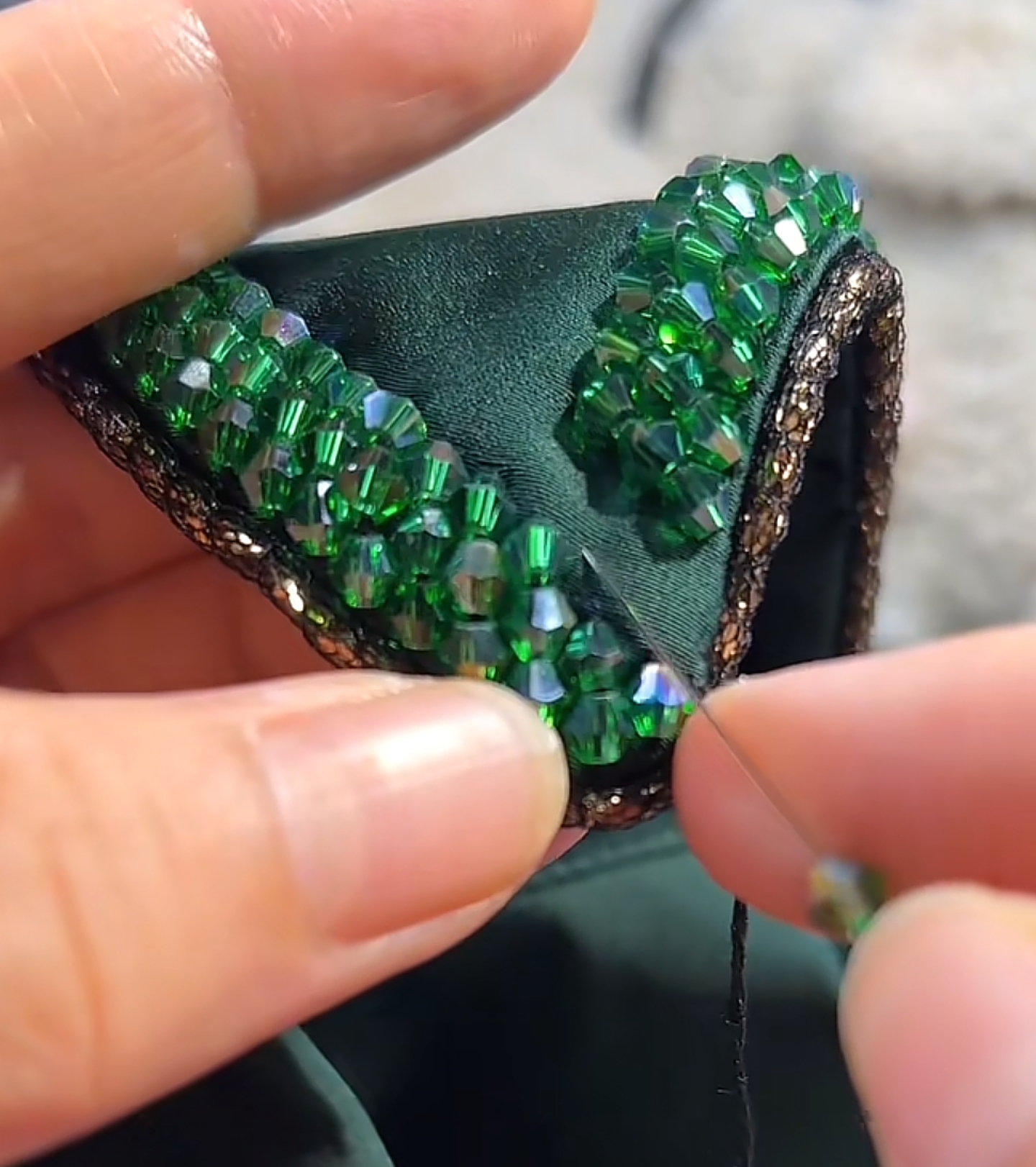
Each bead anchored by hand, one stitch at a time — the slowest and strongest attachment of the three.
Hotfix rhinestone application uses a heated press to bond a pre-set stone, or a rhinestone chain — a continuous trim strip with stones set into a channel — onto the fabric using a heat-activated adhesive backing. It is faster and cheaper than hand beading at volume, but the bond is weaker: fastening strength ranks hand-sewn above hotfix above glued. Like hand beading, hotfix rhinestone runs through a partner facility.
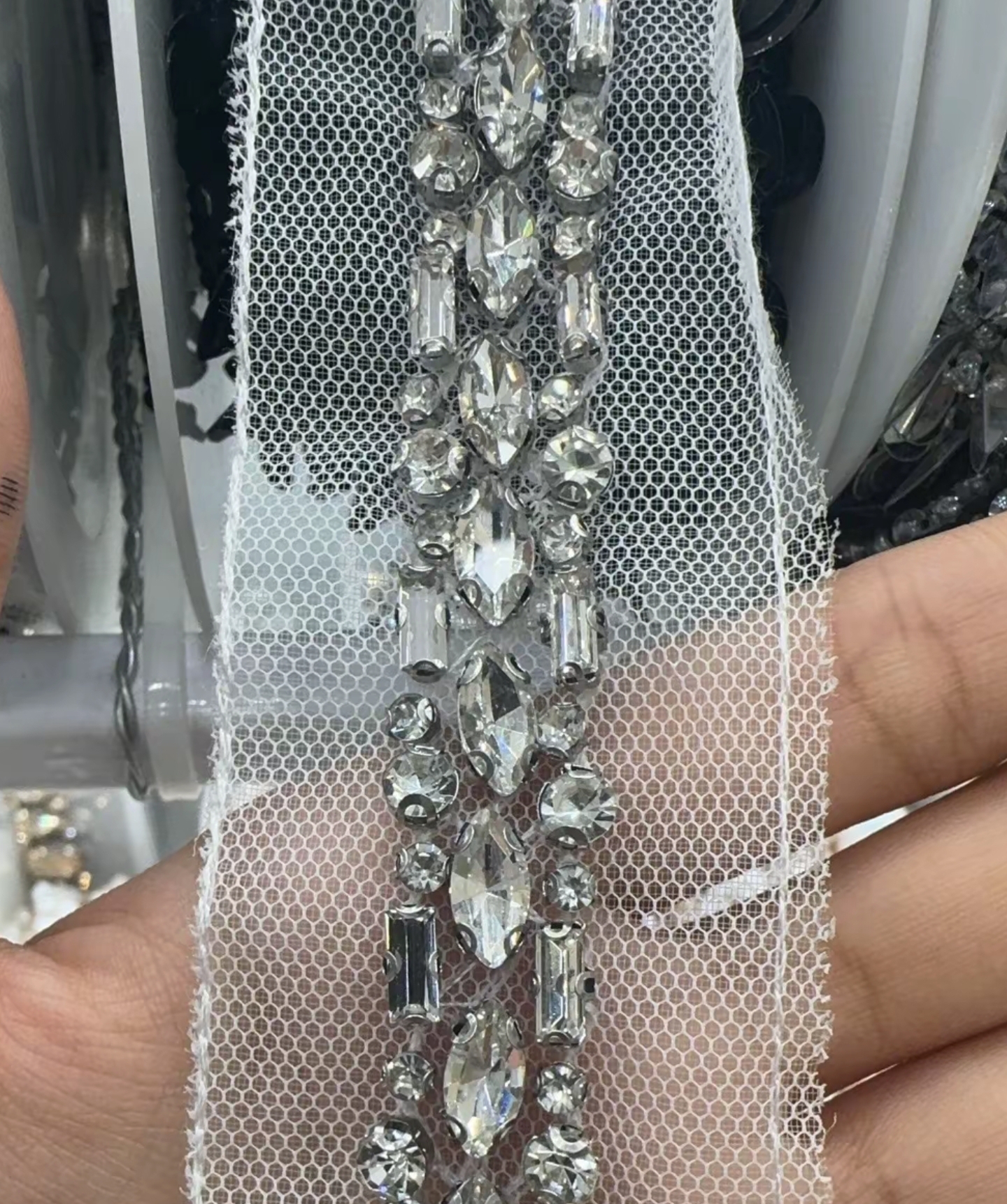
A rhinestone chain trim — stones pre-set in a channel, then heat-pressed onto the garment in one continuous line.
Sequin embroidery is different from both — it runs on the same 24-head embroidery machines we use for lettering and logos, fitted with a sequin device that feeds and tacks individual sequins in a programmed pattern. Because it is machine-driven, it is the one technique in this group we run in-house, and it is the most consistent option for repeating a motif across a full production run. The example below shows the density and layering achievable when sequins and beads are combined on one motif.
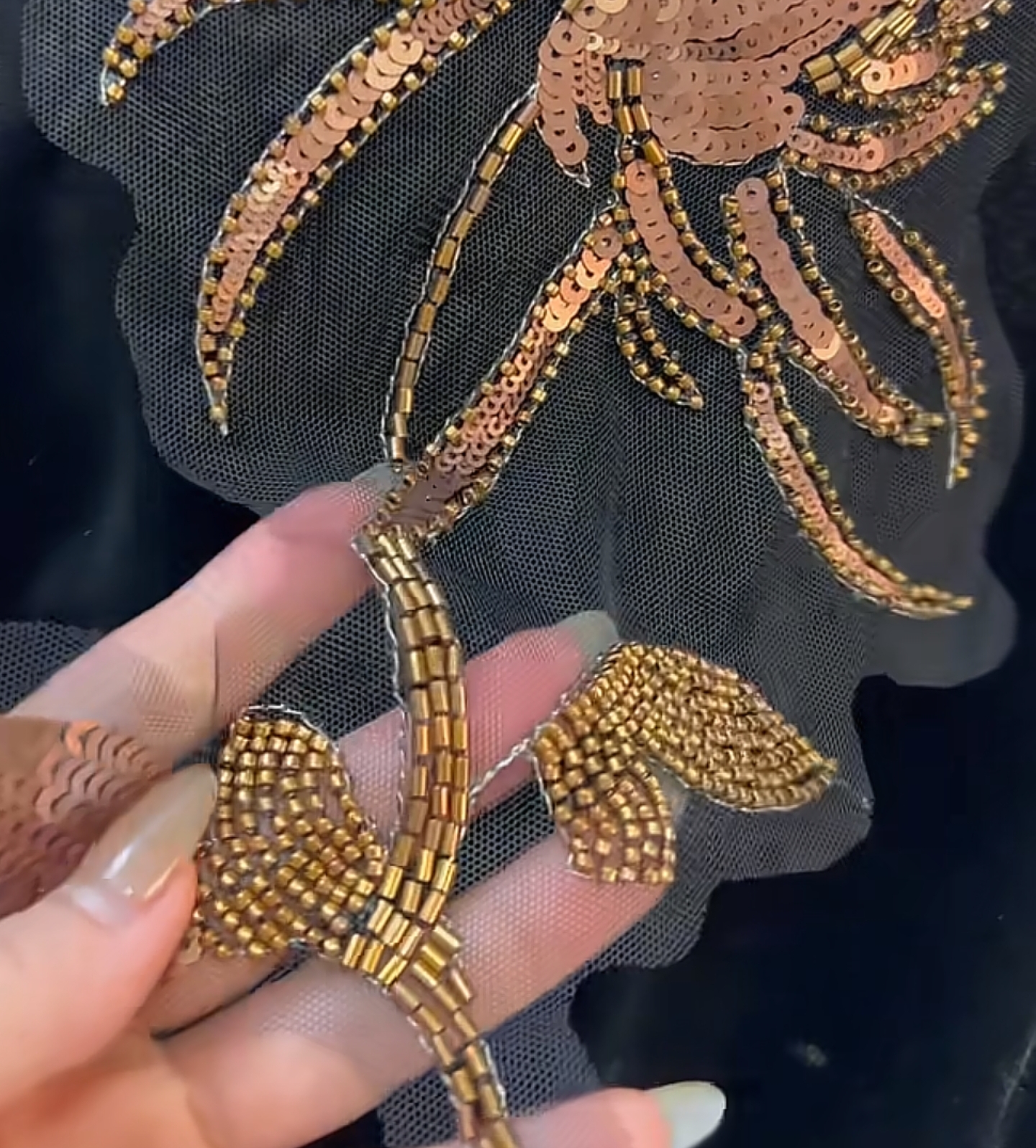
Sequins and beads combined on one motif — production runs repeat a pattern like this through our in-house 24-head machines.
Hand Beading, Rhinestone & Sequin Embroidery Specifications
| Brand | Prophesy Apparel (PRP) |
| Founded | 2015 |
| Techniques covered | Hand beading · Hotfix rhinestone · Sequin embroidery |
| Attribution | Hand beading & hotfix rhinestone — partner network. Sequin embroidery — in-house, 24-head machines |
| MOQ | 50 pieces per style, per colour — across all three techniques |
| Sample lead time | 7–14 days |
| Bulk lead time | 25–45 days |
| Minimum fabric weight for beading | Woven ≥80–100gsm; knits must be interlined |
| Delicate but workable | Chiffon and tulle can be beaded but will sag and distort |
| Unsuitable fabrics | Lightweight knits, high-stretch fabrics, coated fabrics |
| Fastening strength, best to worst | Hand-sewn > Hotfix > Glued |
| Washing — hand beading | Dry-clean or cold hand-wash only, in a mesh bag |
| Washing — hotfix rhinestone | 40°C gentle cycle tolerated, no tumble drying; shedding starts after roughly 20–30 washes |
| Spare-bead packs | Provided with heavily beaded styles |
| Not offered | Scrubs / medical wear |
How Long Hand Beading Actually Takes — And Why It Changes the Price
Hand beading is priced on labour hours, not stone count, because the hours are what actually vary. A worker sets roughly 200–500 beads per hour, so a medium-density front panel typically runs 8–20 hours of hand work. Full-body beading is technically possible, but it runs 40–100+ hours per piece, which is why 20–30% coverage is the practical norm for production orders rather than the exception. Decoration typically accounts for 10–40% of a garment’s cost across all embellishment techniques — heavy hand beading is the one case where it can exceed 100% of the base garment cost. High-end beaded garments usually ship with a small bag of spare beads, which is why we provide them as standard.
Typically in the industry, stacking a second decoration technique through a different partner facility adds roughly 3–5 days to a bulk order; three or more techniques on one style usually adds 7–10 days. Beyond 3–4 decoration operations per garment, bulk lead time starts to suffer, and hand beading is the single largest variable in that math.
When You Should Not Choose Beading, Rhinestone, or Heavy Sequin Work
Beading, rhinestone, and heavy sequin work are not the right call every time a design wants sparkle. Six situations where we would rather steer you toward a different technique — including our 3D silicone patches for a raised logo instead of scattered stones:
- Your fabric is a high-stretch performance knit — beading kills the stretch and threads snap, and a hotfix adhesive bond cracks the first time the fabric flexes hard.
- Your fabric is a lightweight knit without interlining — bead weight pulls and distorts it before the style even ships.
- Your garment is coated or waterproof — both the heat press for hotfix and the needle for hand beading compromise a waterproof coating.
- The garment needs to survive daily machine washing and tumble drying — hand beading is dry-clean or cold hand-wash only, and hotfix rhinestone starts shedding stones after roughly 20–30 washes.
- You want full-body coverage on a tight budget or timeline — full coverage runs 40–100+ hours per piece; most heavily beaded production settles at 20–30% coverage for a reason.
- You are stacking three or more decoration techniques on one style and need a fast bulk lead time — beyond 3–4 decoration operations per garment, lead time starts to suffer.
Hand Beading vs Hotfix Rhinestone vs Sequin Embroidery
Three ways to put sparkle or texture on a garment, and the fabric, budget, and order pattern decide which one actually makes sense. The attachment method is the difference that matters most — it drives strength, wash care, and how the technique is sourced.
| Hand Beading | Hotfix Rhinestone | Sequin Embroidery | |
|---|---|---|---|
| Attachment method | Hand-sewn, one bead at a time | Heat-pressed adhesive backing | Machine-stitched via a sequin device |
| Fastening strength | Strongest of the three | Middle | Machine-consistent |
| Best for | Dense, dimensional, couture-level detail | Flat crystal placement, faster turnaround | Repeating a motif across a full production run |
| Washing | Dry-clean or cold hand-wash only | 40°C gentle cycle, no tumble dry; sheds after ~20–30 washes | Standard care for the base fabric |
| Attribution at PRP | Partner workshop | Partner facility | In-house, 24-head machines |
| Speed at volume | Slowest — 200–500 beads/hr/worker | Faster than hand beading | Fastest — 24 garments per machine pass |
| Cost driver | Labour hours (coverage %) | Stone count and press time | Stitch count, priced like embroidery |
Beading, Rhinestone & Sequin Embroidery Questions Buyers Actually Ask
What's the difference between hand beading, hotfix rhinestone, and sequin embroidery?
Hand beading is manually stitched one bead at a time through a partner workshop and is the strongest attachment of the three. Hotfix rhinestone is heat-pressed onto the fabric through a partner facility and is faster but weaker than hand-sewing. Sequin embroidery runs on our in-house 24-head machines fitted with a sequin device and is the most consistent option for repeating a motif across a production run.
What's the minimum order for beaded or rhinestone styles?
50 pieces per style, per colour — the same minimum as our other embellishment techniques. Unlike silicone patches or embroidery digitizing, beading and rhinestone work don’t carry a separate one-time tooling fee.
How do I wash a hand-beaded garment?
Dry-clean or cold hand-wash only, in a mesh bag. Hotfix rhinestone is more forgiving — it tolerates a 40°C gentle machine cycle with no tumble drying — but it starts shedding stones after roughly 20–30 washes.
What fabrics don't work with beading or rhinestone?
Lightweight knits distort under the bead weight, high-stretch fabrics kill the stretch and can snap threads or crack the hotfix adhesive bond, and coated or waterproof fabrics get compromised by either the needle or the heat press.
How long does hand beading actually take?
A worker sets roughly 200–500 beads per hour, so a medium-density front panel runs about 8–20 hours. Full-body coverage is technically possible but runs 40–100+ hours per piece, which is why most production settles at 20–30% coverage.
Is sequin embroidery the same as hand beading?
No. Sequin embroidery runs on our in-house 24-head embroidery machines fitted with a sequin device — machine-stitched and consistent across a run. Hand beading is manual, slower, and the strongest attachment of the three, done through a partner workshop.
Feel Hand-Sewn, Hotfix, and Sequin Work Side by Side Before You Order
A hand-beaded panel, a hotfix rhinestone chain, and a sequin-embroidered motif can look similar in a flat product photo and feel completely different once you are holding the garment. Request our physical decorated-technique sample card and compare the weight, texture, and finish yourself before committing to a style.
Tell Us the Fabric and the Design
Tell us the fabric, the design, and the quantity, and we will tell you which of the three techniques actually fits — and point you to a different embellishment, like our materials guide, if beading or rhinestone isn’t the right call for your fabric.