Chenille Patches & Appliqué for Garment Manufacturing
Prophesy Apparel (PRP) makes chenille patches and appliqué work as embellishment techniques with hard physical limits — not as decoration that can be scaled to any size a design file happens to specify. Chenille needs a minimum letter height to read at all. Appliqué needs a base fabric that will not distort under the weight of the shape stitched to it. Brands come to us when a varsity jacket, a heavy fleece or a wool melton piece carries lettering or motifs that a general cut-and-sew factory will accept the file for and then get wrong.
Minimum letter height
5 cm
roughly 2 inch — below this chenille lettering closes up and stops reading
Minimum stroke width
8 mm
the looped pile needs this much room to sit without merging into itself
MOQ, per style per colour
50 pcs
same minimum across all six embellishment techniques
Attribution
Partner network
chenille patches and appliqué are made in our production network, not on our own floor
What Chenille Patches and Appliqué Actually Are
Chenille is a looped yarn embroidery worked onto a base material — classically wool felt, though twill and leather bases are also normal. The yarn is laid in dense rows of loops that stand up off the base, which is where the plush, slightly furry surface of a varsity letter comes from. The patch is finished, cut to its outline, and then attached to the garment as a separate piece. Because the structure is built from loops rather than flat stitches, it has a floor below which detail simply disappears.
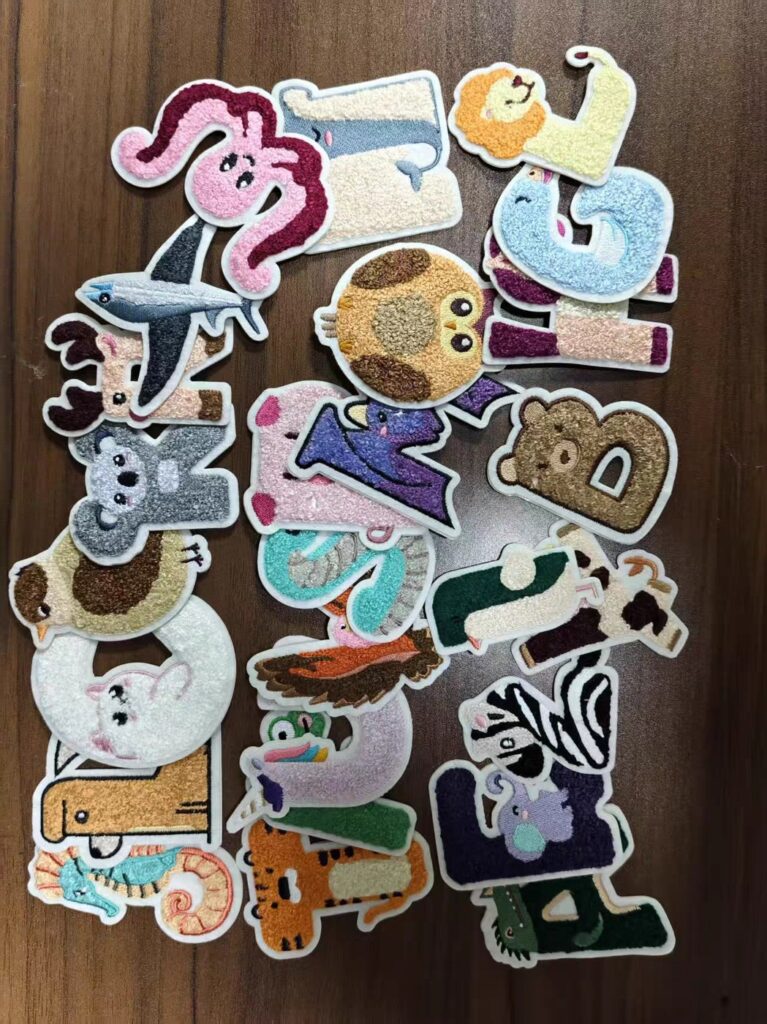
Looped chenille yarn on a felt base. The pile height is what gives the letter its hand feel — and what sets the minimum size.
Appliqué is a different operation. A fabric shape is cut, positioned on the garment panel, and stitched down along its edge with a satin or zigzag stitch that both secures it and finishes the raw edge. Nothing is built up in pile, so an appliqué sits much flatter than chenille and can hold finer outlines. The shapes are cut first — for clean outlines we take AI, EPS or PDF files with fonts converted to outlines.
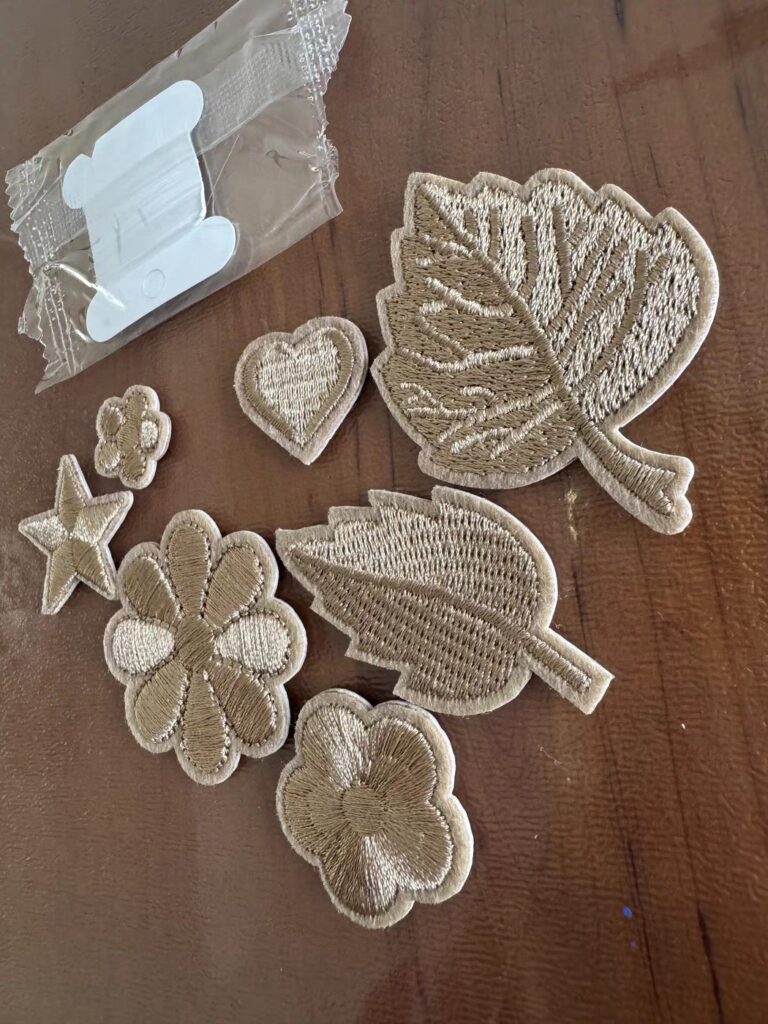
Appliqué motifs cut and edge-finished before application. Each outline is a separate stitched edge, which is why shape complexity drives the price.
The two techniques are routinely combined. A chenille letter can carry an appliqué detail inside it; an appliqué panel can be outlined in chenille cord. They can also be layered — one fabric shape stitched over another to build depth without the bulk of a pile — and finished with beadwork, which is covered on our beading and rhinestone page.
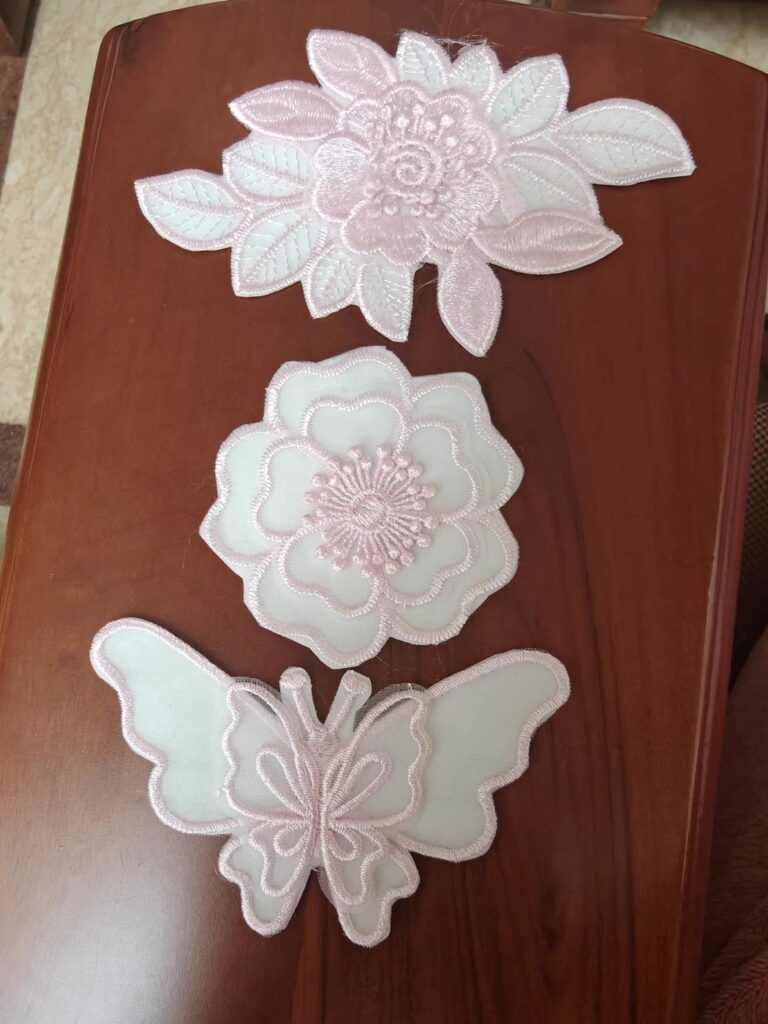
Layered appliqué: separate fabric shapes stitched over one another, with beaded centres added as a third pass.
Chenille & Appliqué Specifications
| Brand | Prophesy Apparel (PRP) |
| Founded | 2015 |
| Techniques covered | Chenille patches · Appliqué · Layered appliqué |
| Attribution | Chenille patches and appliqué — our production network. Chenille / towel embroidery worked directly onto the garment runs on our in-house 24-head embroidery line |
| MOQ | 50 pieces per style, per colour |
| Sample lead time | 7–14 days |
| Bulk lead time | 25–45 days |
| Minimum letter height | roughly 5cm (2 inch) |
| Minimum stroke width | roughly 8mm |
| Suitable fabrics | Heavy wovens, melton wool, twill, canvas, denim, heavy fleece |
| Unsuitable fabrics | Lightweight knits, stretch fabrics, wovens under 120gsm, waterproof-coated fabrics |
| Patch size | Body up to roughly 30×30cm is typical in the industry; varsity back patches commonly run 30–40cm |
| Yarn colours | Typically 1–3 yarn colours plus the felt base colour; more are possible, each adding a process step |
| Base options | Felt (classic varsity), twill, leather |
| Attachment | Sewn — lasts the life of the garment. Heat-press alone — edges lift after 10–20 washes |
| Artwork files | AI / EPS / PDF, fonts converted to outlines |
| Not offered | Scrubs / medical wear |
Why Chenille Has a Minimum Size — And What Happens Below It
This is the part that costs brands a sampling round, so it is worth stating plainly. Chenille is built from yarn loops standing off a base. A loop has a physical diameter. To render a stroke, you need enough width to fit loops side by side and still leave the gap between strokes visible. Below roughly 8mm of stroke width, the loops from adjacent strokes touch and the counter spaces — the holes inside an A, an R, a B — fill in. The letter stops being a letter and becomes a fuzzy mass.
The same constraint sets the roughly 5cm minimum letter height. A 5cm capital in a normal weight gives you strokes in the 8–12mm range. Scale that letter down to 3cm and the strokes drop to 5–7mm, which is under the floor. This is why a logo that embroiders beautifully at 3cm cannot simply be re-run in chenille at the same size — flat satin-stitch embroidery works down to roughly 5mm letter height, chenille does not come close to that.
There are two honest ways out when a design is too small for chenille. Either the artwork is redrawn heavier and larger, or the element is moved to a technique that holds fine detail — flat embroidery, appliqué, or a 3D silicone patch, which reproduces small type cleanly because it is moulded rather than stitched. We will tell you which one your file needs before sampling, not after.
When You Should Not Choose Chenille or Appliqué
Both techniques are wrong for a number of real briefs, and it is cheaper to hear that now.
Do not put chenille on lightweight or stretch fabric. A chenille patch has real mass. On a lightweight knit it drags the panel out of shape and the distortion is permanent. On stretch fabric the patch does not move with the garment, so the fabric ripples around a rigid island. Wovens under 120gsm pucker and bubble at the attachment stitching. If the fabric is light, the decoration has to be light too — flat embroidery or a printed treatment, not a built-up patch.
Do not specify chenille on waterproof-coated fabric. Attachment means needle holes through the coating, and needle holes are where the waterproofing stops being waterproof.
Do not use heat-press attachment on anything that gets washed. Adhesive backing is fine for a display sample or a garment that will never see a laundry cycle. On a piece that washes, the edges lift after roughly 10–20 washes and the patch curls. If it will be washed, it gets sewn.
Do not choose chenille for fine type or intricate marks. Covered above — below roughly 5cm letter height and 8mm stroke width the technique cannot render the shape, and no amount of care at the machine changes that.
Do not choose chenille purely on cost. It is the most expensive of the common patch routes. If the brief is a small logo on a chest position and the brand does not specifically want the plush varsity look, a woven label or a tackle twill patch does the job for less.
Fabric choice drives most of these calls, which is why we ask about the base cloth before the artwork. Our materials page covers how the fabric decision constrains what decoration is available.
Chenille vs Appliqué vs Tackle Twill vs Woven Label
Four ways to put a name, number or motif on a garment. They differ on cost, how much detail they hold, how they survive washing, and what they can sit on.
| Chenille patch | Appliqué | Tackle twill patch | Woven label | |
|---|---|---|---|---|
| Relative cost | Highest of the four | Mid — driven by outline complexity | Below chenille | Lowest |
| Surface | Raised looped pile, plush hand feel | Flat fabric shape, satin-stitched edge | Flat twill, satin-stitched edge | Flat woven, no relief |
| Detail resolution | Coarse — roughly 5cm letters, 8mm strokes minimum | Fine outlines possible; limited by cut accuracy | Medium — finer than chenille, coarser than woven | Finest of the four |
| Durability | Sewn: life of the garment. Heat-press only: edges lift after 10–20 washes | Stitched into the panel — as durable as the seam | Sewn: life of the garment | Sewn: life of the garment |
| Works on | Heavy wovens, melton wool, twill, canvas, denim, heavy fleece | Most stable wovens and medium knits with backing | Heavy wovens and medium knits | Almost anything, including light fabric |
| Avoid on | Lightweight knits, stretch, under 120gsm, waterproof-coated | High-stretch fabric without backing | Lightweight and high-stretch fabric | — |
| Typical use | Varsity lettering, back patches, heavy outerwear | Motifs and colour-blocked shapes on panels | Team numbering, sports lettering | Brand labels, care and size marking |
The cost ranking is the practical takeaway: chenille sits above tackle twill, which sits above a woven label. You are paying for dedicated equipment and the yarn, not for stitch count. If the plush raised look is the point of the design, that premium is what buys it. If it is not, one of the other three is the better call.
Chenille & Appliqué Questions Buyers Actually Ask
What is the minimum size for chenille lettering?
Roughly 5cm (2 inch) letter height and roughly 8mm stroke width. Chenille is a coarse looped yarn structure, so anything finer closes up and the letter reads as a fuzzy blob rather than a shape. This is the single most common thing buyers get wrong — a logo that works at 3cm in embroidery will not work at 3cm in chenille.
What is the difference between a chenille patch and an appliqué?
A chenille patch is a finished piece — looped yarn worked onto a felt, twill or leather base, cut to shape, then attached to the garment. An appliqué is a fabric shape stitched directly onto the garment panel with a satin or zigzag edge. Chenille gives height and a plush hand feel; appliqué sits flatter and can carry finer detail.
Which fabrics do chenille patches not work on?
Lightweight knits (the patch weight distorts them), stretch fabrics, wovens under 120gsm (they pucker and bubble around the patch), and waterproof-coated fabrics. Chenille belongs on heavy wovens, melton wool, twill, canvas, denim and heavy fleece.
Can chenille patches be heat-pressed instead of sewn?
They can, but only for garments that will not be washed. Heat-press alone lifts at the edges after roughly 10–20 washes. Anything that goes through a laundry cycle must be sewn — sewn attachment lasts the life of the garment.
How does chenille compare on price to other patch types?
Chenille is the most expensive of the three common patch routes: chenille costs more than tackle twill, which costs more than a woven label. The gap comes from dedicated equipment and the yarn itself, not from the stitch count.
What is the minimum order for chenille or appliqué styles?
50 pieces per style, per colour — the same minimum that applies across our other embellishment techniques. Most factories that handle heavy embellishment want 300+ pieces before they will quote. We start at 50.
Feel the Pile Height Before You Commit to It
Chenille is hard to judge from a screen — the whole point of it is a surface you feel rather than see. Our embellishment sample card carries real swatches of chenille, pleating, laser cutting, silicone patch, beading and specialty embroidery so you can handle the finishes side by side before specifying one. Tell us where to send it. Shipping is at the buyer’s cost.
Tell Us the Fabric and the Artwork Size
Send the base fabric, the artwork, and the size you want it at, and we will tell you whether chenille will hold the shape — and what to move it to if it will not. Minimum is 50 pieces per style, per colour. Most factories that handle heavy embellishment want 300+ before they will quote.