
A school-programme buyer sent us a varsity letter design last season — a 20cm chenille M in three yarn colours, felt base, going on the back of a lightweight nylon-shell jacket the brand had already committed to for the season. On paper it was a normal job. The letter was well over the size chenille needs, the colour count was ordinary, the quantity was fine. The problem was the jacket.
We told them it would pucker. They sampled it anyway, which is reasonable — nobody should take a factory’s word for a thing they can hold. The sample came back with the letter sitting flat and clean on the table, and rippled the moment it went on a hanger. That is the whole failure mode in one sentence, and it is worth understanding properly, because it is not a workmanship problem and no amount of care at the machine fixes it.
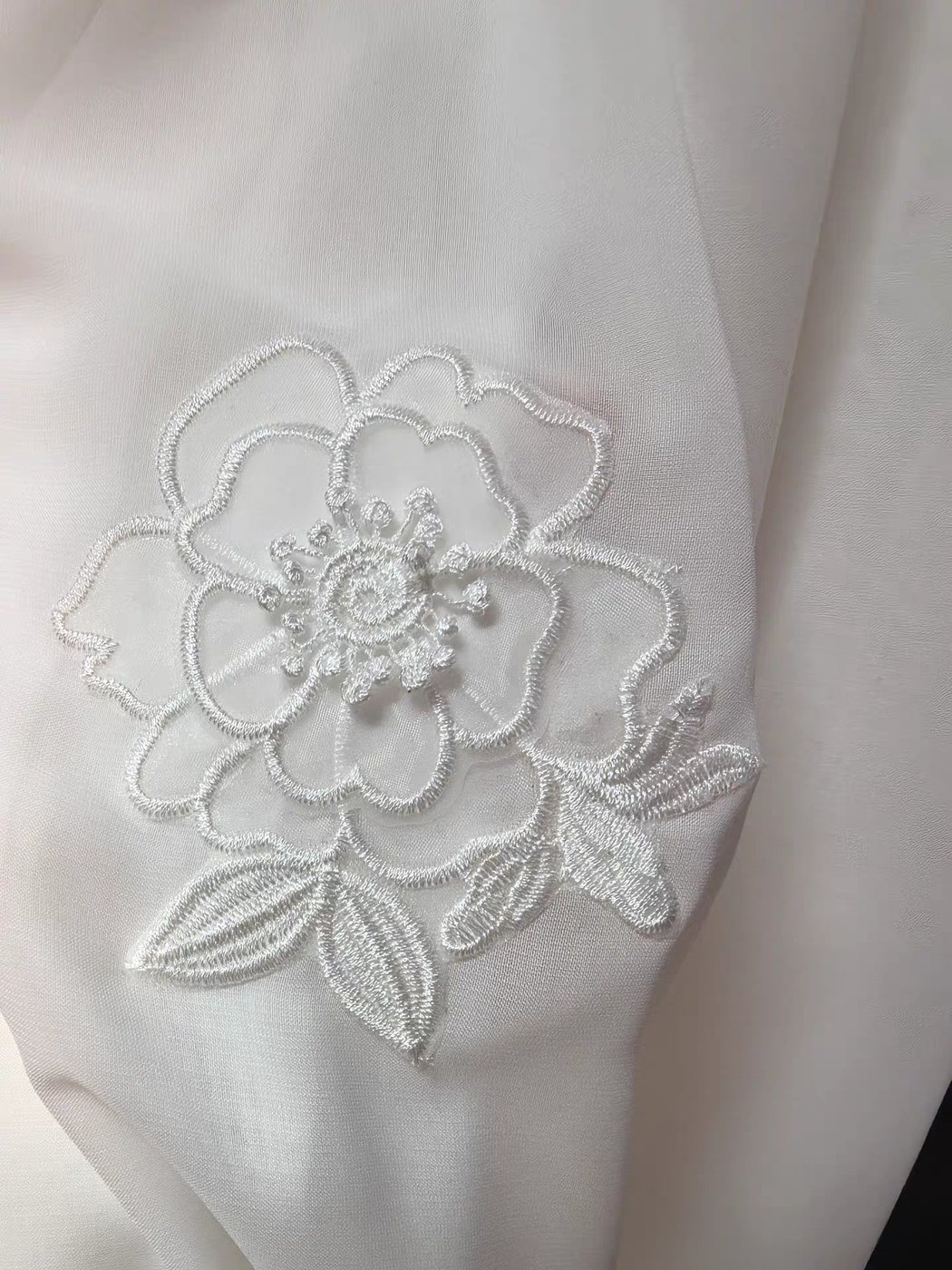
A flat embroidered motif on lightweight woven — this works because the decoration adds almost no mass. The same fabric under a chenille patch behaves completely differently.
What is actually happening
A chenille patch is not a graphic printed onto cloth. It is a physical object: looped yarn worked onto a felt, twill or leather base, cut to shape, and then attached as a separate piece. It has real mass and, more importantly, it has real stiffness. Once it is stitched down, that area of the garment can no longer move independently of the patch.
Fabric drapes. A patch does not. On a heavy woven — melton wool, canvas, denim, heavy fleece — the cloth has enough body of its own that it and the patch behave similarly, and the join reads as intentional. On a lightweight cloth, the fabric wants to fall and fold freely while the patch stays rigid, so the fabric gathers at the boundary. That gathering is the pucker. It shows up under load — hanging, wearing, moving — which is precisely why it is invisible on a flat sampling table.
The same logic explains a second failure people report separately but which has the same cause: lightweight knits distort rather than pucker. A knit stretches, the patch does not, and the knit ends up permanently pulled out of shape around a rigid rectangle. High-stretch fabrics are the extreme version of this and should be ruled out immediately.
The weight line to work from
The practical threshold is around 120gsm. Below that, wovens pucker and bubble at the attachment stitching, and it is not a marginal effect you can sample your way out of. Above it, you are into the territory where chenille was designed to live.
Treating 120gsm as a hard gate rather than a guideline saves a sampling round, and on a school or team programme with a fixed delivery date, a wasted sampling round is usually the difference between shipping on time and not. The fabric decision has to come before the decoration decision, which is the general point our materials page is built around.
What each fabric actually does
| Base fabric | What happens with a sewn chenille patch | Better route if it fails |
|---|---|---|
| Melton wool, heavy twill, canvas, denim, heavy fleece | Works as intended — this is what chenille was made for | — |
| Mid-weight woven, above roughly 120gsm | Generally fine; check the patch size against the panel size | Keep the patch under about 30×30cm on a front panel |
| Woven under roughly 120gsm | Puckers and bubbles at the stitch line, visible when hung or worn | Appliqué with backing, or a flat embroidered mark |
| Lightweight knit | Distorts permanently under the patch weight — does not recover | Flat embroidery with cut-away backing |
| High-stretch fabric | Fabric ripples around a rigid island; worst case of the four | Print, transfer, or move the decoration to a stable panel |
| Waterproof-coated shell | Needle holes destroy the waterproof performance regardless of weight | Non-perforating treatment only |
Attachment does not fix it — but it decides what happens next
A question that comes up here is whether heat-pressing instead of sewing avoids the problem. It does not, and it introduces a different one.
Heat-press attachment alone lifts at the edges after roughly 10–20 washes. For a display sample or a garment that genuinely never gets laundered that can be acceptable. For a school programme, a team kit, or anything a customer will actually wash, it is not — the patch curls at the corners and the garment looks neglected long before the fabric wears out. Anything that will be washed gets sewn, and sewn attachment is exactly the thing that reveals whether the base fabric can carry the patch.
So the sequence is: fabric weight decides whether chenille is viable at all; attachment method decides how long it survives. They are separate questions and collapsing them is how briefs go wrong.
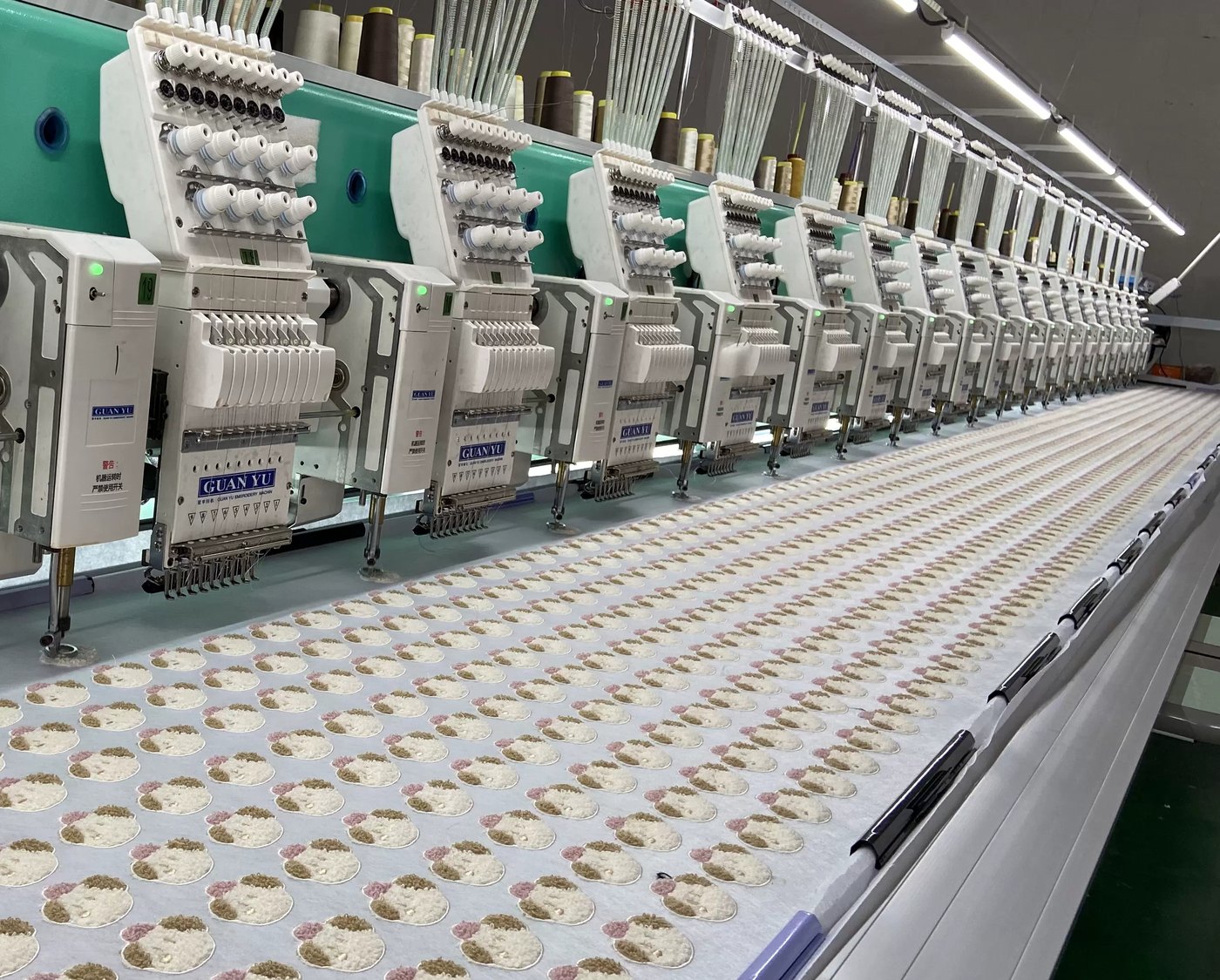
Motifs produced in rows on our in-house embroidery line. Flat stitched decoration adds very little mass, which is why it survives on fabrics that chenille cannot go near.
Where this reasoning does not apply
Three honest limits on everything above.
It is about chenille patches specifically, not all decoration. Appliqué — a fabric shape stitched flat onto the panel with a satin edge — sits much flatter and adds far less mass, so it survives on fabrics where a chenille patch will not. A lightweight cloth that rules out chenille often still takes appliqué perfectly well with the right backing. The two are covered together on our chenille and appliqué page because buyers routinely conflate them, but they behave differently here.
Weight is not the only gate. Chenille also has a size floor — roughly 5cm letter height and 8mm stroke width, below which the looped structure closes up and the shape stops reading. A heavy canvas jacket will carry a chenille patch beautifully and still be the wrong place for a small detailed logo. If the mark is small, a moulded 3D silicone patch reproduces detail that chenille physically cannot.
A thick fabric is not automatically a safe one. A heavy waterproof-coated shell is well over 120gsm and still a bad idea, because the failure there is perforation of the coating rather than distortion of the cloth. Weight and coating are independent checks.
What to send us
The base fabric with its weight, the artwork, and the finished size you want the mark at. That is enough for us to say whether chenille holds the shape on that cloth, and what to move it to if it does not — before anyone pays for a sample. Minimum is 50 pieces per style, per colour. Most factories that handle heavy embellishment want 300+ before they will quote.
For uniform and team programmes, where the fabric is often fixed by the spec before decoration is discussed, it is worth raising the decoration question early — we cover how those programmes are usually structured on our school uniform programme page.
Frequently asked questions
What fabric weight do you need for a chenille patch?
As a working floor, wovens under roughly 120gsm will pucker and bubble around the attachment stitching. Chenille belongs on heavy wovens, melton wool, twill, canvas, denim and heavy fleece. If the base cloth is lighter than that, the problem is not the sewing — it is that the fabric cannot carry the patch.
Can you put a chenille patch on a nylon windbreaker?
Usually not, for two separate reasons. Most shell fabrics are well under 120gsm, so they distort around the patch. And if the shell is waterproof-coated, the attachment stitching punches holes through the coating, which is where the waterproofing stops working. A printed or heat-transferred treatment is the honest answer on a shell.
Why does my patch look fine flat but pucker when worn?
Because a flat table supports the fabric and a body does not. Off the table the cloth hangs from the shoulders and the patch becomes a rigid island in a surface that wants to drape around it. Any sampling review done flat will miss this — hang the sample or put it on a body before approving.
Does sewing or heat-pressing cause the puckering?
Neither causes it on its own; the fabric weight does. But the attachment choice decides what happens next. Heat-press alone lifts at the edges after roughly 10–20 washes, so on anything that gets laundered the patch must be sewn — and sewn attachment is exactly what shows puckering on a fabric too light to carry it.
What should I use instead on lightweight fabric?
Appliqué with the right backing, flat embroidery, or a moulded patch, depending on the design. A moulded silicone patch is often the best answer for small or detailed marks because it adds far less mass than chenille and reproduces fine detail that chenille cannot hold at all below roughly 5cm letter height.
Related Manufacturing Services
Ready to Start Your Clothing Project?
- MOQ from 50 pieces per style
- OEM and private label production
- Sample development support
- Fabric sourcing
- Quality inspection before shipment
- Worldwide shipping support