
Most brands who send us a beading enquiry are describing one of three different jobs. One wants glass beads sewn by hand across the bodice of an evening dress. One wants rhinestones pressed onto a slip dress for a party capsule. The third has a screenshot of a sequinned jacket and wants to know why the first quote they got was so much higher than they expected.
These are three separate processes. They use different equipment, attach in different ways, need different care labels and are priced on completely different logic. Treating them as one thing is the most common mistake we see in this category, and it usually comes to light at the sample stage, which is the most expensive place to find it.
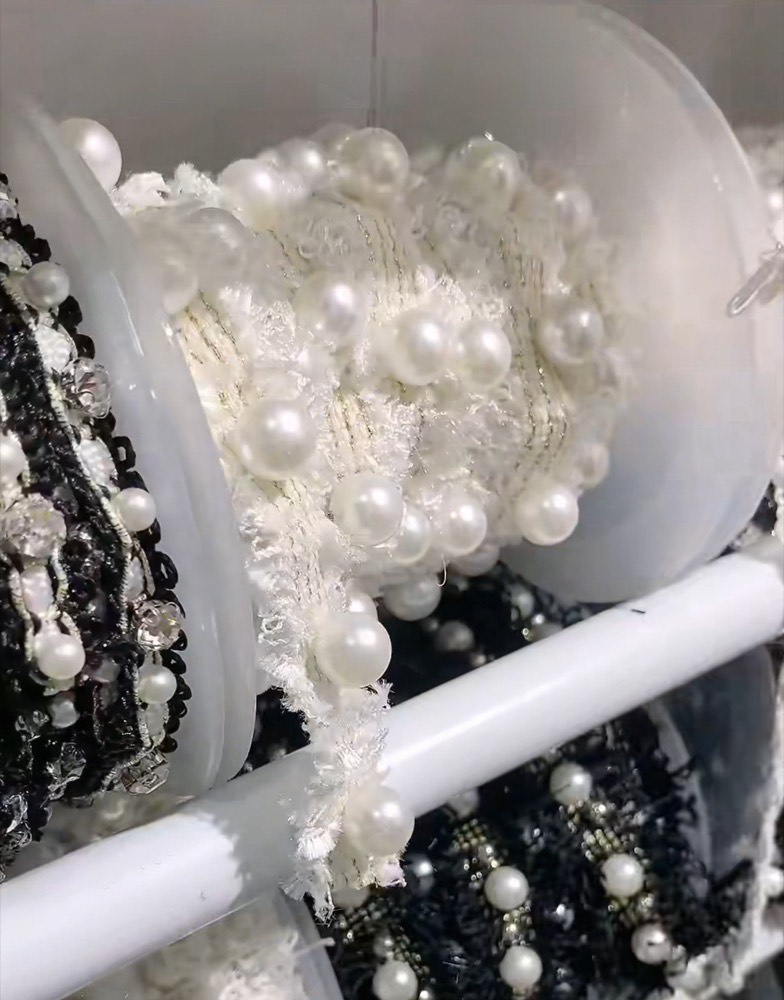
Pearl and bead trims on reels. Trim like this is sewn on by hand. Nothing on it is pressed or glued, and that decides how the finished garment can be washed.
Three processes, not one
Hand beading is a worker with a needle and thread, sewing beads through the fabric one at a time. No machine does this part, so speed is the whole constraint. Typical figures across the industry are 200–500 beads per hour per worker, and roughly 8–20 hours for a medium-density front panel. Full-body beading can be done, but it typically runs 40–100+ hours per piece, which is why most beaded designs in the trade stay at around 20–30% coverage. At Prophesy Apparel (PRP), hand beading is done by a partner workshop in our production network.
Hotfix rhinestones work on a different principle. Each flatback stone carries a heat-activated adhesive on its base. The stones are laid out on the fabric and heat-pressed, and the adhesive bonds them to the cloth. A press finishes in minutes what hand-setting would take hours to do. From a metre away it can pass for sewn work, but the attachment is glue, and everything about the care label follows from that. PRP runs hotfix work through a partner facility.
Machine sequins, usually called sequin embroidery, run on an embroidery machine fitted with a sequin device. The device feeds sequins off a reel and the machine stitches each one down. It is sewn, not glued. This is the one of the three that PRP does in-house, on the same 24-head line that runs our multi-head embroidery.
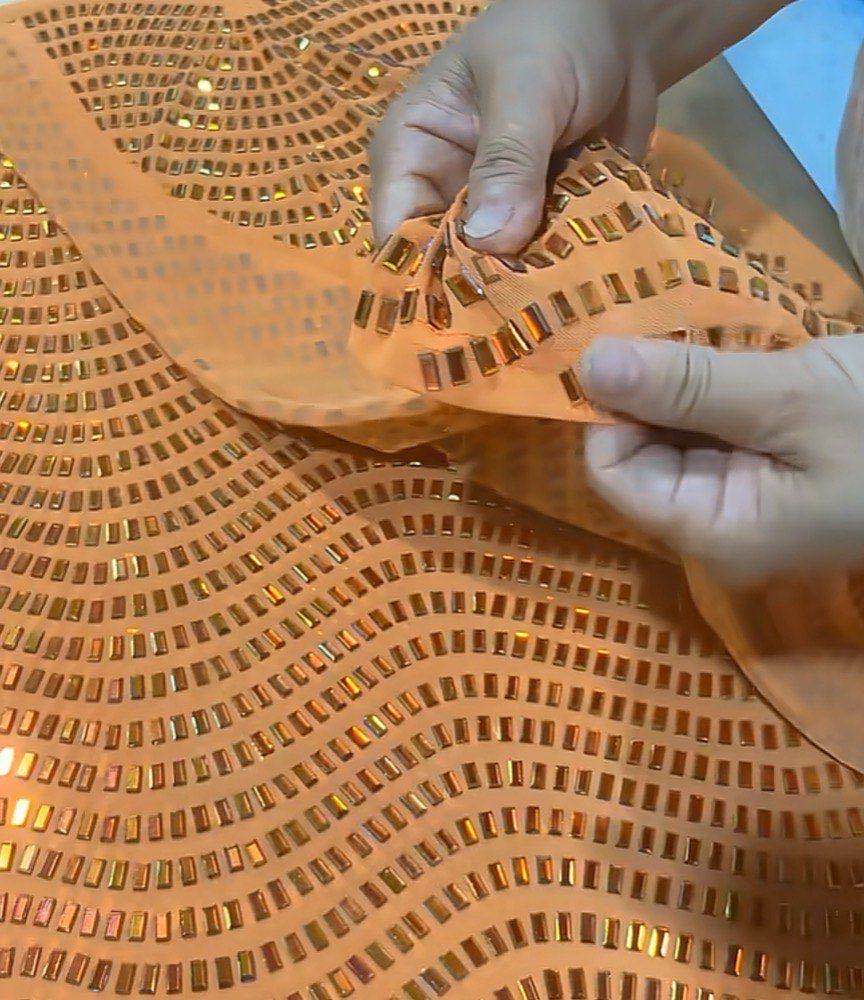
Rows of rectangular stones on a light mesh. On a base this fine and this mobile, how the stones are attached matters more than which stones are chosen.
How they compare
| Hand beading | Hotfix rhinestones | Machine sequins | |
|---|---|---|---|
| How it attaches | Sewn through the fabric by hand | Heat-activated adhesive, pressed on | Machine-stitched through each sequin |
| Time per piece | Industry norm: 8–20 hours for a medium front panel | Minutes | Machine run time |
| Care label | Dry-clean, or cold hand-wash in a mesh bag | 40°C gentle cycle, no tumble dry; sheds after roughly 20–30 washes | Set by a wash test on the approved sample |
| Base fabric | Woven at least 80–100gsm; knits must be interlined | Test-press on the actual base cloth first | Stable base with backing under the stitched area |
| What drives the price | Labour hours | Stone count and press time | One-time digitizing fee, then machine time |
| Where PRP makes it | Partner workshop | Partner facility | In-house, 24-head line |
Why the attachment method decides everything
For holding power the ranking is fixed: hand-sewn first, hotfix second, glue-only last. A thread through the cloth does not care how many times the garment bends.
Hand-sewn beads stay on. The cost of that strength is paid on the care label, not at the bead: dry-clean, or a cold hand-wash in a mesh bag. That one line rules hand beading out of anything the end customer will put in a washing machine every week.
Hotfix stones handle a 40°C gentle cycle with no tumble dryer, and start shedding after roughly 20–30 washes. That is not a defect. It is the limit of an adhesive bond on fabric that flexes in a drum. For a dress worn a handful of times a season it is plenty. For a garment that will be washed every week, it is not.
Machine sequins are stitched, so they sit on the sewn side of that ranking. How many washes a sequinned piece survives depends on the sequin film and the stitch density of that particular design, so the honest answer is a wash test on the approved sample before the care label goes to print, not a number quoted in advance.
Where each one does not work
Every factory can tell you what a technique does. These are the cases where we would steer you away from it.
Hand beading is the wrong choice on high-stretch fabric: the beading kills the stretch and the threads snap when the cloth is pulled. Lightweight knits distort around the bead weight unless they are interlined. Chiffon and tulle can be beaded, but they will sag and distort, and the design has to allow for that. Coated fabrics are off the list. And because of the care label, it does not belong on activewear or on any basics the end customer will machine-wash.
Hotfix rhinestones should not go on a garment whose care label needs to say tumble dry, or on anything expected to outlast 20–30 washes with the stones intact. Coated fabrics are on the unsuitable list for this whole category. Because the bond is made with heat, run a test press on the real base cloth before the bulk specification is fixed.
Machine sequins cannot hold fine detail. Even flat satin embroidery bottoms out at roughly 5mm letter height, and a sequin is a solid disc, so thin strokes and small text break down into a blur. Sequins also add weight and stiffness to the area they cover, which matters on a bias-cut dress or anything built around drape. If the decoration is really a logo, our comparison of silicone patches and embroidery compares the two usual routes for small marks.
And for all three: if your run is under 50 pieces per style, per colour, we cannot take it.
How each one is priced
The three are not priced on the same logic, which is why quotes for what looks like the same dress can differ so much.
Hand beading is priced by time. The quote is a labour rate multiplied by the beading hours per piece. Across the industry, decoration typically accounts for 10–40% of garment cost, and heavy hand beading can exceed 100% of it on its own. Beaded garments from PRP ship with a small pack of spare beads, because sooner or later one comes loose.
Hotfix rhinestones are priced by material and press time. Labour is low; stone count drives the number.
Machine sequins carry a one-time digitizing fee of USD 40–100 per style, to build the machine file, and then machine time. Spread across the order, the fee looks like this:
| Quantity | USD 40–100 one-time fee, per piece |
|---|---|
| 50 pcs | USD 0.80 – 2.00 |
| 100 pcs | USD 0.40 – 1.00 |
| 300 pcs | USD 0.13 – 0.33 |
| 500 pcs | USD 0.08 – 0.20 |
At 50 pieces the fee is visible in the unit price. At 500 it barely registers.
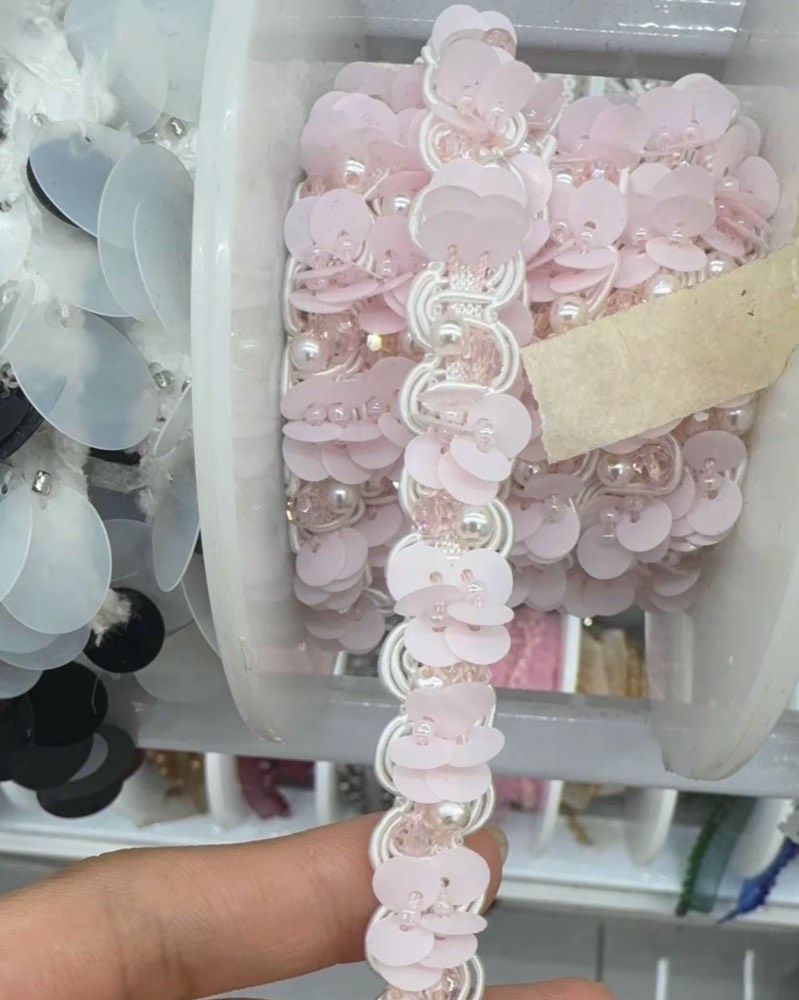
Sequin trim on a reel. Sequins strung on a braid are a fourth thing again: a trim, sewn on as a strip. It is worth naming which one you mean when you ask for a quote.
The two mistakes that cost the most at sampling
The first: a brand sends a photo of a machine-sequinned jacket and asks for the same beading. If it gets quoted as hand beading, the price is built on labour hours the original garment never had, and the sample comes back looking nothing like the reference. Before anyone quotes, someone has to say which of the three the photo actually shows.
The second: the decoration is chosen before the care label. Hotfix on a dress that has to say tumble dry. Hand beading on a piece the customer will machine-wash. Both read fine on the tech pack and both fail in the customer’s laundry.
Three questions catch both before a sample is cut:
- Is the attachment sewn through the fabric, or pressed on with heat?
- What will the care label say?
- Will the end customer tumble-dry, dry-clean or machine-wash this garment?
The answers usually rule out one or two of the three techniques straight away.
Minimums, sampling and lead time
All three techniques start at 50 pieces per style, per colour. Three colourways of one style is a 150-piece minimum. Samples take 7–14 days; bulk takes 25–45 days from the approved sample.
Mixing techniques on one garment adds time. As a general industry pattern, each extra technique routed through a different partner facility adds roughly 3–5 days, and hand beading is the single biggest variable in any multi-technique schedule. A dress that combines hand beading with machine sequins should be planned with that in mind.
For machine sequins, send a DST or EMB file, or vector artwork and we digitize it. The rest of the file rules are in our artwork file requirements guide. Dress and eveningwear labels working on a first beaded collection will find the wider production picture on our fashion brands page.
Bead types, stone options and the difference between scattered and continuous coverage are on the beading and rhinestone page, which sits with the other techniques we run under embellishment. If you already have a reference photo, send it over and we will tell you which of the three it is before we price it.
FAQ
What is the difference between hand beading and hotfix rhinestones?
Hand beading is sewn: a worker stitches each bead through the fabric with needle and thread. Hotfix rhinestones are glued: each flatback stone has a heat-activated adhesive on its base and is heat-pressed onto the cloth. Sewn beads hold better, but the garment has to be dry-cleaned or hand-washed cold. Hotfix stones tolerate a 40°C gentle machine cycle with no tumble drying, and start to shed after roughly 20–30 washes.
How many washes do hotfix rhinestones last?
Roughly 20–30 washes on a 40°C gentle cycle, with no tumble drying. After that the adhesive starts to let go and stones shed. If the care label needs to say tumble dry, hotfix is the wrong technique for that garment.
Can you bead stretch fabric?
Not high-stretch fabric. Hand beading kills the stretch and the threads snap when the fabric is pulled. Lightweight knits also distort under bead weight. A knit can be beaded only if it is interlined under the beaded area; wovens need to be at least roughly 80–100gsm to carry the weight.
Is sequin embroidery the same as hand beading?
No. Sequin embroidery is a machine process: an embroidery machine with a sequin device feeds sequins from a reel and stitches each one down. At Prophesy Apparel it runs in-house on our 24-head embroidery line. Hand beading is done by hand, one bead at a time, at a partner workshop, and is priced by labour hours rather than machine time.
What is the minimum order for beaded or rhinestone garments?
50 pieces per style, per colour, for all three techniques. Three colourways of the same style means a 150-piece minimum. Samples take 7–14 days and bulk production 25–45 days from the approved sample.
Related Manufacturing Services
Ready to Start Your Clothing Project?
- MOQ from 50 pieces per style
- OEM and private label production
- Sample development support
- Fabric sourcing
- Quality inspection before shipment
- Worldwide shipping support