
Decorating Wovens and Satin: Which Fabrics Hold a Pleat, a Bead, a Laser Edge or a Patch
On a woven, the fibre decides almost every decoration question. A polyester satin takes a permanent pleat and a sealed laser edge; a silk satin of the same look scorches under the laser and is not a fibre we heat-set. Prophesy Apparel (PRP) cuts on a 3-metre-format laser and runs embroidery and sequin embroidery on our own 24-head line; pleating, hand beading, hotfix rhinestone, chenille and silicone patches go through our production network. Below is which woven carries which decoration, and the combinations we turn down before sampling.
Fabric a heat-set pleat uses
the flat yardage of the same panel
Laser cutting format
a full dress front in one piece, in-house
Woven weight for hand beading
chiffon and tulle sag below that
MOQ, per style per colour
same minimum on pleated and beaded styles
Satin Is a Weave, Not a Fibre
“Satin” describes how the yarns are interlaced, not what they are made of. A satin can be polyester, acetate, silk or viscose, and two satins that look identical on a swatch card behave in opposite ways once heat, a needle or a laser touches them. The same is true of chiffon, georgette, twill and poplin. So on a woven the first question is always the fibre content, then the weight.
Heat-set pleating needs a thermoplastic fibre. Polyester, polyester blends, acetate and nylon take a permanent pleat; lightweight wovens — chiffon, georgette, satin, taffeta — pleat best. Cotton, linen and viscose collapse on the first wash. Our pleating and smocking page covers pleat types and panel limits.
The laser reads fibre the same way. Polyester and nylon wovens seal at the cut. Cotton, linen, silk and wool scorch to a brown edge with a smoke smell. Details on our laser cutting page.
Weight decides what the fabric can carry. Hand beading needs a woven of roughly 80–100gsm or more; chenille needs a heavy woven and puckers on anything under 120gsm. The beading and rhinestone and chenille and appliqué pages set out each technique’s fabric limits.
On our lines, wovens mostly mean dresses, skirts, jumpsuits and playsuits — pleated dresses are the main use of the pleating work — plus heavier wovens for cargo pants and jackets.
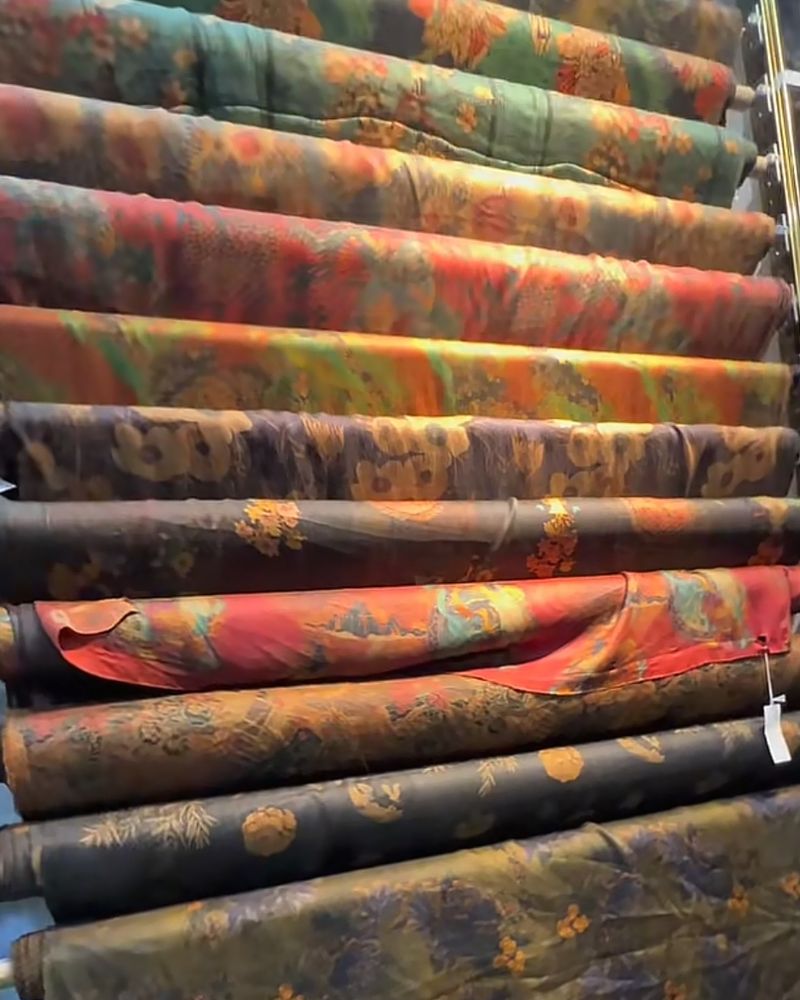
Printed woven rolls. The print says nothing about the fibre — the composition label decides whether a pleat or a laser edge will hold.
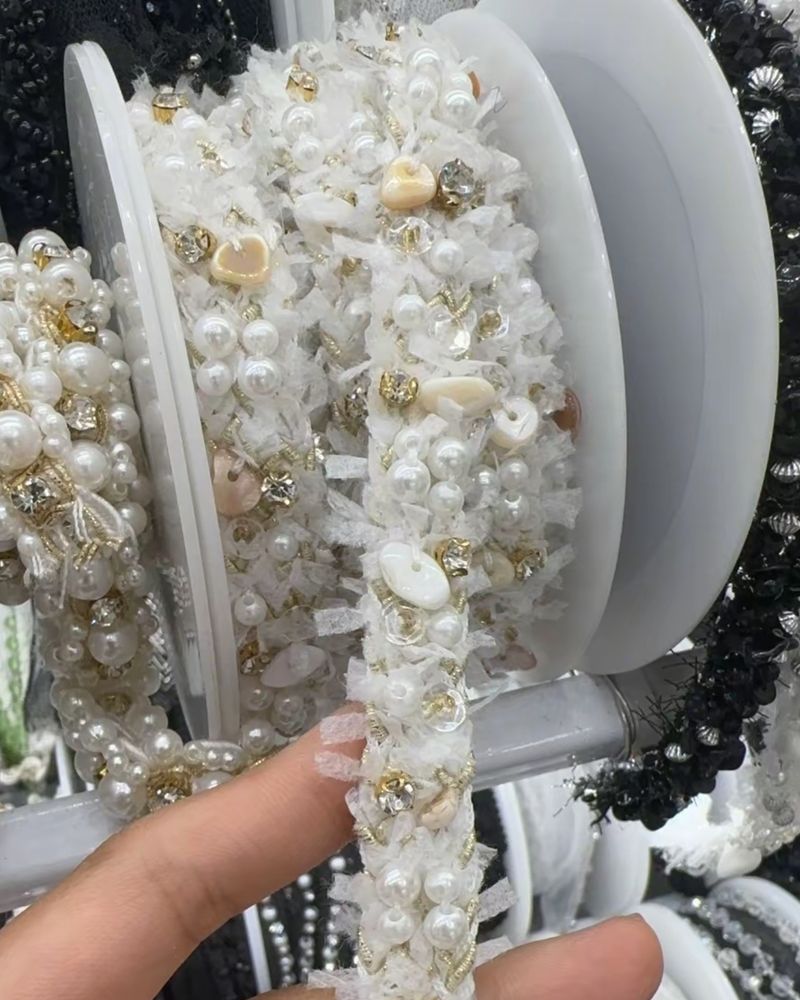
Pearl, shell and sequin trims on spools. Each one adds weight to the panel it is sewn to, which is why light chiffon sags under dense beadwork.
Woven and Satin Decoration Specifications
| Brand | Prophesy Apparel (PRP) |
| Founded | 2015 |
| MOQ | 50 pieces per style, per colour |
| Sample lead time | 7–14 days |
| Bulk lead time | 25–45 days from approved sample |
| Woven garments we sew | Dresses (woven), pleated dresses and skirts, jumpsuits and playsuits; heavier wovens for cargo pants and jackets |
| Heat-set pleating | Partner facility. Polyester, polyester blends, acetate, nylon; best on lightweight chiffon, georgette, satin, taffeta. Not on 100% cotton, linen or viscose/rayon; nothing over 200gsm takes a crisp pleat. Uses 2.5–3× the flat yardage. Pleating panels in the industry typically run 110–150cm wide × 200–300cm long |
| Shirring and smocking | Partner facility. Held by stitching, so cotton can be shirred and smocked even though it cannot be heat-set pleated |
| Laser cutting | In-house, 3-metre format, roll-fed with no panel piecing. Polyester and nylon wovens seal and do not fray; cotton, linen, silk and wool scorch — dark fabric or concealed edges only, and the edge must be finished. Minimum hole about 0.5–1mm, minimum line about 1mm; bridges under 1.5mm burn through. PVC is never laser cut |
| Hand beading | Partner workshop. Woven of about 80–100gsm or more; chiffon and tulle can be beaded but sag and distort; not on coated fabrics. Dry clean or cold hand wash in a mesh bag. Spare-bead pack supplied |
| Hotfix rhinestone | Partner facility. 40°C gentle cycle, no tumble drying; stones start shedding after roughly 20–30 washes |
| Sequin embroidery | In-house, on the 24-head embroidery line |
| Chenille patches & appliqué | Partner facility. Heavy wovens, melton wool, twill, canvas, denim. Wovens under 120gsm pucker and bubble. Sewn on for any garment that will be washed |
| 3D silicone patches | Partner facility. Heat press about 150–170°C for 10–15 seconds. Ultralight polyester glazes or melts, wool felts, waterproof-coated wovens lose the coating — sew-on version on those. Mould fee USD 40–100 one-time per style |
| Embroidery | In-house, 24 heads. Ultralight wovens need backing; not on waterproof-coated fabric. Digitizing fee USD 40–100 one-time per style |
| Not offered | Scrubs / medical wear |
When the Woven Is the Wrong Base for the Decoration
Most woven decoration requests arrive as a mood-board image of a pleated or beaded dress, with the fabric still undecided. These are the combinations we flag before a sample round:
Heat-set pleats in cotton, linen or viscose satin. These fibres are not thermoplastic, so the pleat collapses on the first wash. If the design needs texture on cotton, it becomes shirring or smocking, held by stitching. Our note on why pleats fall out of cotton explains the physics. If it needs a real pleat, the fabric moves to polyester or acetate — see decorating polyester and poly blends.
A laser-cut visible edge on silk satin or linen. Natural fibres scorch at the cut, leaving a brown edge and a smoke smell. It is usable only on dark fabric or on an edge that ends up hidden, and the edge then needs finishing. A cut-out pattern on a light silk dress is a polyester satin job. Our test on laser cutting cotton fabric shows the same effect on cotton.
Dense hand beading on chiffon. Chiffon and tulle can be beaded, but they sag and distort under the weight. Heavy beadwork goes on a woven of about 80–100gsm or more — a satin bodice, or a backed panel — with the chiffon left light. Where the effect matters more than the hand-sewn finish, our comparison of hand beading, hotfix rhinestones and machine sequins sets out the trade-offs.
A chenille patch on a lightweight satin or poplin. Wovens under 120gsm pucker and bubble around the patch. Chenille belongs on twill, canvas, denim and melton wool; our article on why chenille patches pucker on lightweight fabric shows what goes wrong.
A heat-pressed silicone patch on ultralight polyester or wool. At 150–170°C ultralight polyester glazes or melts and wool felts. Those garments take the sew-on version of the 3D silicone patch.
Anything needle-based on a waterproof-coated woven, and any laser work on PVC. Needle holes destroy waterproof performance, and coated fabric is unsuitable for beading and chenille too. PVC is never laser cut: it releases chlorine gas, which is toxic and corrodes the machine.
Polyester Satin vs Silk or Viscose Satin vs Cotton vs Heavy Wovens: Which Decoration Works
Four woven groups cover nearly every brief we receive. Fibre and weight decide each cell. Where a cell says “judged at sampling”, there is no single rule we would put in writing.
| Technique | Polyester or acetate chiffon, georgette, satin, taffeta | Silk or viscose satin | Cotton and linen wovens (poplin, lawn) | Heavy wovens (twill, canvas, denim, melton wool) |
|---|---|---|---|---|
| Heat-set pleating | Best base — permanent on 100% polyester | Viscose collapses on first wash; silk is not a fibre we heat-set | Collapses on first wash — shirr or smock instead | No crisp pleat over 200gsm |
| Laser-cut visible edge | Seals, no fray | Silk scorches brown; viscose judged at sampling | Scorches brown; dark fabric or concealed edge only | Cotton and wool scorch; polyester canvas or twill seals |
| Hand beading | Chiffon sags; satin and taffeta carry it from about 80–100gsm | Carries it from about 80–100gsm; dry clean or cold hand wash | Carries it from about 80–100gsm | Carries it |
| Chenille patch, sewn | No — under 120gsm puckers | No — under 120gsm puckers | Light poplin puckers; heavier cotton twill works | Best base |
| 3D silicone patch | Sew-on version on ultralight polyester | Judged at sampling | Heat-pressed | Heat-pressed on cotton twill and denim; sew-on on wool |
| Embroidery and sequin embroidery | Backing needed on ultralight weights | Backing needed on ultralight weights | Works | Works; not on waterproof-coated canvas |
Yardage, Washing and Cut Size: Where Woven Decoration Costs Come From
Pleating cost is mostly fabric. A heat-set pleat consumes 2.5–3× the flat yardage — accordion pleats about 2.5–3×, knife pleats about 3×. That, not the pleating labour, is what moves the price of a pleated dress. Sunray pleats need a dedicated mould and are typically the most expensive type in the industry. The table below is straight multiplication on those ratios, before cutting allowance.
| Finished pleated panel | Accordion pleat (about 2.5–3×) | Knife pleat (about 3×) |
|---|---|---|
| 1 metre of skirt hem | 2.5–3 metres of fabric | about 3 metres of fabric |
| 50 skirts × 1.5m hem | about 190–225 metres | about 225 metres |
Care decides which decoration a buyer can live with. A pleat on 100% polyester survives repeated washing below 40°C; above 60°C or in a hot tumble dryer it drops out, and a 65/35 poly-cotton pleat softens after roughly 10–20 washes. Hand beading is dry clean or cold hand wash in a mesh bag; hotfix rhinestones take a 40°C gentle cycle with no tumble drying and start shedding after roughly 20–30 washes. Fastening strength runs hand-sewn, then hotfix, then glued. A beaded dress ships with a spare-bead pack.
Hand beading is priced in hours. In the industry a beader typically sews 200–500 beads per hour, a medium-density front panel takes roughly 8–20 hours, and full-body beading runs 40–100+ hours per piece — which is why 20–30% coverage is the practical norm.
The 3-metre laser changes what can be cut in one piece. Standard machines in the industry are 1300×900mm or 1600×1000mm. Our 3-metre format cuts roll-fed with no panel piecing, so a whole dress front, a long coat panel or a full-body cut-out pattern on polyester satin comes out as one continuous piece. Laser files come as AI, EPS or PDF with fonts converted to outlines.
Stacking techniques adds time. A pleated skirt with a beaded bodice touches two partner facilities. As a general industry pattern, each additional technique routed through a different partner adds roughly 3–5 days, and three or more add roughly 7–10 days, with hand beading the largest single variable. Our 50-piece minimum per style, per colour holds on pleated and beaded styles: most factories that handle heavy embellishment want 300+ pieces. We start at 50.
For knit bases see decorating jersey and knits; for cotton twill, canvas and denim see decorating cotton and cotton blends. Every fabric we cut and sew is on our materials overview, and every technique is in the embellishment hub.
Feel a Heat-Set Pleat and a Sealed Laser Edge Before Ordering
How crisp a polyester pleat is, how a sealed laser edge feels on satin and how heavy hand beading sits on a panel do not show in a product photo. Our embellishment swatch card carries real samples of pleating, laser cutting, silicone patches, beading, chenille and specialty embroidery. The card is free; shipping is paid by the buyer, and we confirm the cost before anything ships.
Woven and Satin Decoration Questions Buyers Actually Ask
Can satin be permanently pleated?
Polyester and acetate satin can. On 100% polyester the pleat is permanent and survives repeated washing below 40°C, but drops out above 60°C or in a hot tumble dryer. Viscose satin collapses on the first wash, and silk is not on the list of fibres we heat-set.
Does a laser-cut edge fray on satin or chiffon?
Not on polyester or nylon: the cut seals and does not fray. Silk, cotton and linen scorch to a brown edge instead, usable only on dark fabric or a concealed edge. Minimum holes are about 0.5–1mm, and bridges under 1.5mm burn through.
Can chiffon be hand beaded?
Yes, but chiffon and tulle sag and distort under the weight. Hand beading wants a woven of about 80–100gsm or more, so dense beadwork usually sits on a satin bodice or a backed panel. Hand-beaded pieces are dry clean or cold hand wash only, and ship with a spare-bead pack.
Why does a pleated dress cost more than a flat one?
Mainly fabric. A heat-set pleat uses 2.5–3 times the flat yardage — about 3 times for knife pleats — so a 1-metre hem needs roughly 2.5–3 metres of cloth. The pleating labour is the smaller part of the difference.
Can a chenille patch go on a satin jacket?
Not on a light satin shell: wovens under 120gsm pucker and bubble around a chenille patch. Heavy wovens — twill, canvas, denim, melton wool — carry it, sewn on rather than heat-pressed for anything that will be washed.
What is the minimum order for a pleated or beaded woven style?
50 pieces per style, per colour, so three colourways of one dress means 150 pieces. Most factories that handle heavy embellishment want 300+ pieces. We start at 50.
Send Us the Fabric and the Decoration
Send the fibre content, the weight, the decoration and the quantity. If the woven will not hold what the design needs — a heat-set pleat in viscose, a light laser edge on silk, dense beads on chiffon — we say so before a sample round, not after. Email works too: tkandyyu01@gmail.com.