
A typical sportswear brief we get looks like this: a training top in polyester/spandex, a raised logo on the chest, laser-cut vents down the back, and some sparkle on the shoulder for the launch shoot. Every one of those can be made. The question the brief usually does not ask is which of them will still be on the garment after a season of weekly washing and hard stretching.
Decoration on activewear fails for two reasons that do not apply to most fashion pieces: the fabric moves a lot, and the garment goes through the washing machine after every wear. Some embellishment techniques are built for that. Some are not, and no amount of care at the factory changes it.
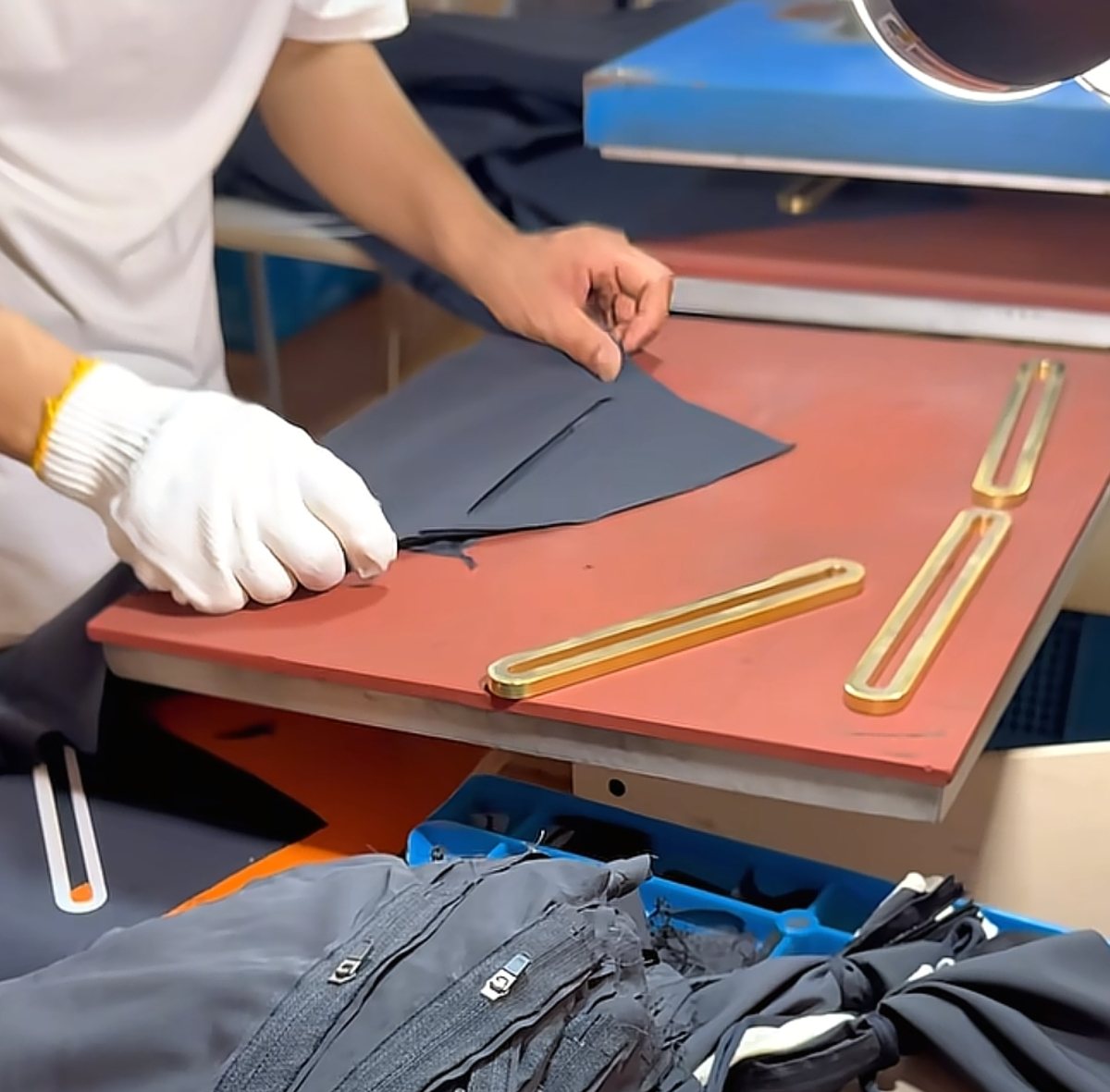
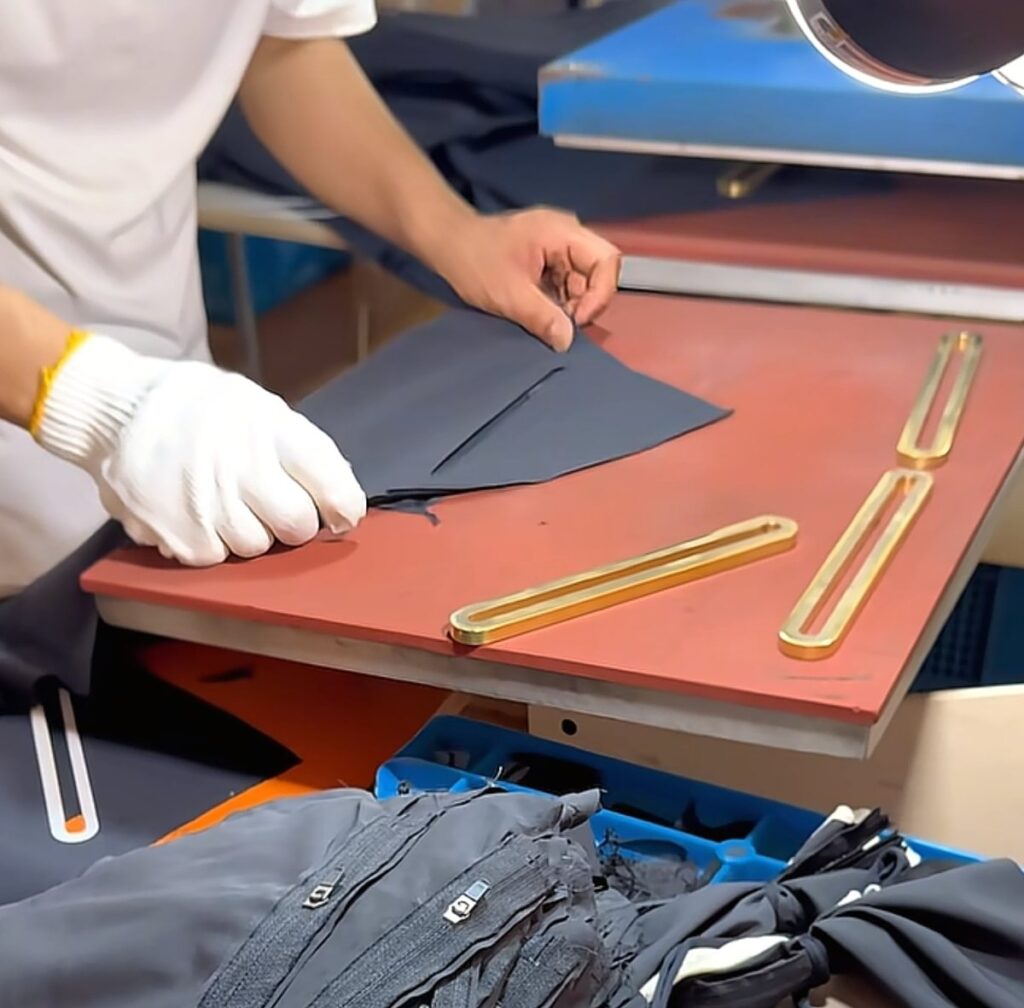
Positioning a dark technical fabric panel on a heat press, with two brass slot-shaped frames on the platen. Anything pressed on with heat is limited by what the base fabric can take.
Start with the fabric and the care label
Most activewear sits between 150 and 280gsm, and the stretch fabrics in that range are usually blends such as nylon/spandex 80/20 or polyester/spandex 87/13. Those two facts, the fibre and the weight, decide most of the embellishment question before design comes into it.
The other half is the care label. If the end customer is going to machine-wash the piece every week, anything that needs dry-cleaning or a cold hand-wash is out, and anything held on by adhesive will be tested hard. Settle the care label first, then choose the decoration that can live with it.
Laser cutting: the most activewear-friendly option
Laser cutting suits synthetic performance fabric better than any other technique on this list, because the laser seals the edge as it cuts. Polyester, nylon, polyester mesh, neoprene and scuba all self-seal: the cut edge does not fray and needs no hem or binding. On a vented back panel or a perforated sleeve, that means no extra stitching where the fabric needs to move.
There are physical limits. Holes can go down to roughly 0.5–1mm, and lines to about 1mm; below that the fabric tears. Bridges between cut-outs under about 1.5mm burn through, and isolated islands drop out. A ventilation pattern with dense, tiny perforations needs to be checked against those numbers before sampling, not after.
Two cautions. Cotton-rich athleisure fabric does not seal; it scorches brown and smells of smoke, which is covered in detail in can you laser cut cotton fabric. And the published list of sealing fabrics is polyester, nylon, mesh, neoprene and scuba. A blend with a high elastane content should be test-cut on the actual roll before the pattern is fixed.
Prophesy Apparel (PRP) runs laser cutting in-house on a 3-metre format machine. Standard machines are 1300×900mm or 1600×1000mm, so a 3-metre bed can cut a full-length panel in one pass without piecing.
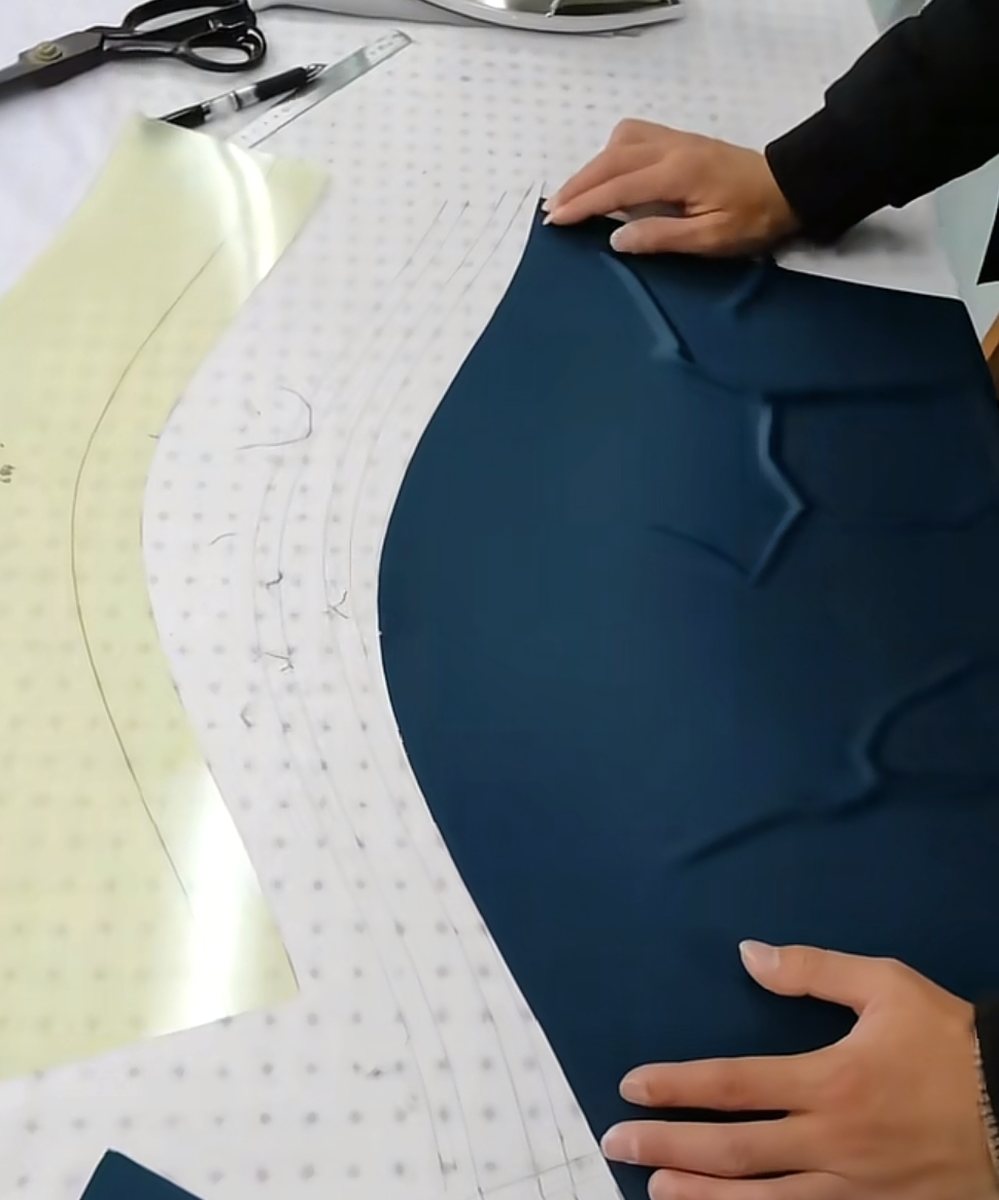
A curved panel laid out against its paper pattern. Cutting by blade leaves a raw synthetic edge that has to be finished; a laser-cut synthetic edge is sealed as it is cut.
3D silicone patches: durable, with a fabric caveat
Silicone patches are a common choice for gym wear logos, and for good reason. Pressed correctly, typically at 150–170°C for 10–15 seconds, a silicone patch survives 50+ washes at 40°C. When one does fail, the edge lifts; the silicone itself does not break down.
The caveat is the base fabric. Thin nylon distorts under the press and ultralight polyester glazes or melts. Both are common in running and training tops. On those fabrics the sew-on version of the patch is the right choice, not the heat-press version. Waterproof-coated fabric is also off the list for heat-pressing, because the press destroys the coating.
Silicone patches carry a one-time mould fee of USD 40–100 per style. At 50 pieces that adds USD 0.80–2.00 per piece; at 500 it adds USD 0.08–0.20. The full cost breakdown is on the 3D silicone patch page, and the comparison with stitched logos is in how durable are silicone patches compared to embroidery. PRP produces silicone patches through a partner facility in our production network.
Pleating: works on polyester sports skirts
Polyester is thermoplastic, so a heat-set pleat on polyester is permanent. That makes pleated court and tennis-style skirts a good fit, as long as the fabric stays under about 200gsm; heavier fabric will not take a crisp pleat. The pleat survives repeated washing below 40°C. Above 60°C, or in a hot tumble dryer, it drops out, so that has to go on the care label. Pleating runs through a partner facility; the details are on the pleating and smocking page.
Rhinestones and beading: mostly not for training wear
Hotfix rhinestones handle a 40°C gentle cycle with no tumble drying, and start shedding after roughly 20–30 washes. On a dance or performance piece worn a handful of times a season, that is enough. On a training top washed every week, it is roughly half a year.
Hand-sewn beading is a clear no on high-stretch fabric. The beading kills the stretch and the threads snap when the fabric is pulled, and the care label would have to say dry-clean or cold hand-wash. Both techniques, and the difference between them, are on the beading and rhinestone page.
Embroidery and chenille: only with support
Embroidery on a high-stretch knit needs a cut-away backing behind the design, or the fabric distorts around the stitching. With the right backing it is workable; PRP runs it in-house on a 24-head embroidery line. Chenille is a different matter: stretch fabrics and lightweight knits are both on its unsuitable list, because the patch weight pulls the fabric out of shape.
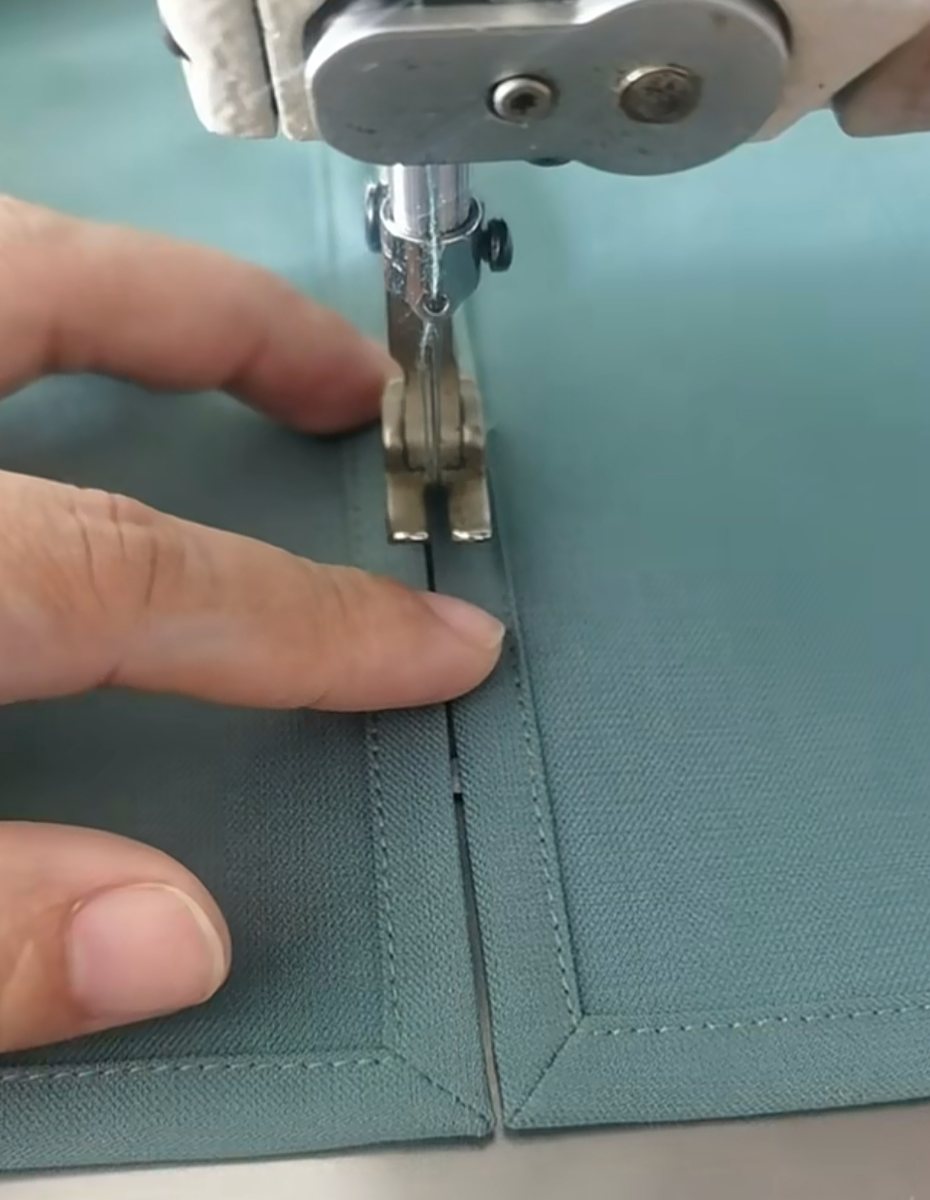
Topstitching on a stable woven. On a woven the stitch line sits flat; on a high-stretch knit the same needle work needs backing behind it, or the fabric distorts.
How they compare on stretch performance fabric
| Technique | On stretch synthetics | Wash limit | How it usually fails | Where PRP makes it |
|---|---|---|---|---|
| Laser cutting | Yes: polyester, nylon, mesh, neoprene and scuba seal | Sealed edge, no hem needed | Bridges under ~1.5mm burn through; cotton scorches | In-house, 3-metre format |
| 3D silicone patch (heat-press) | Yes, except thin nylon and ultralight polyester | 50+ washes at 40°C | Edge lift | Partner facility |
| Heat-set pleating | Polyester under ~200gsm | Below 40°C; drops out above 60°C | Pleat drops in a hot dryer | Partner facility |
| Hotfix rhinestones | Stable base only | 40°C gentle, no tumble dry; sheds after ~20–30 washes | Stones shed | Partner facility |
| Hand beading | No on high-stretch | Dry-clean or cold hand-wash | Threads snap, stretch is lost | Partner workshop |
| Embroidery | Only with cut-away backing | Set by wash test on the sample | Fabric distorts around the stitching | In-house, 24 heads |
| Chenille patch | No | Must be sewn, not pressed | Patch weight distorts the knit | Partner facility |
When this advice does not apply
This guide is about knit performance fabric. It does not hold for three common cases.
- Waterproof or water-resistant coated shells. Heat-pressing destroys the coating, embroidery needle holes destroy the water resistance, and coated fabric is on the unsuitable list for beading. Decoration on a coated shell has to be planned separately and tested on the actual fabric.
- Cotton-heavy athleisure. Cotton scorches under the laser, and a heat-set pleat on 100% cotton collapses on the first wash. The rules above for polyester do not carry over.
- Runs under 50 pieces per style, per colour. That is our minimum for every embellishment technique, so a 20-piece team order with one colourway is below what we can take.
Sampling and lead time
Every technique here starts at 50 pieces per style, per colour. Samples take 7–14 days, and bulk takes 25–45 days from the approved sample. Combining techniques adds time: as a general industry pattern, each extra technique routed through a different partner facility adds roughly 3–5 days. A top with laser-cut vents (in-house) and a silicone chest patch (partner facility) should be planned with that in mind.
For laser cutting, send the cut-out artwork as AI, EPS or PDF with fonts converted to outlines. Whatever the technique, run a wash test on the approved sample, on the real fabric, before the care label goes to print.
For the print side of a sportswear order, sublimation, screen print and heat transfer are compared in our custom sportswear manufacturer guide. For fabric, seam and specification details on performance and team wear, see our sportswear brands page. All the decoration techniques we run are collected under embellishment. If you have a design with vents, patches or trims already sketched, send it over with the fabric composition and we will tell you which parts will survive the wash before we quote.
FAQ
Can you laser cut polyester and nylon activewear fabric?
Yes. Polyester, nylon, polyester mesh, neoprene and scuba all self-seal under the laser, so the cut edge does not fray and needs no hem or binding. Holes can go down to roughly 0.5–1mm, but bridges between holes under about 1.5mm burn through. Cotton-rich fabric is different: it scorches brown instead of sealing. At Prophesy Apparel (PRP) laser cutting is in-house on a 3-metre format machine.
Do silicone patches stay on gym wear?
Correctly heat-pressed at roughly 150–170°C for 10–15 seconds, a silicone patch survives 50+ washes at 40°C. When it fails, the edge lifts; the silicone itself does not break down. Thin nylon and ultralight polyester are the exceptions: thin nylon distorts and ultralight polyester glazes under the press, so on those fabrics the sew-on version is the right choice.
Can you put rhinestones on stretch activewear?
Hotfix rhinestones tolerate a 40°C gentle cycle with no tumble drying, and start shedding after roughly 20–30 washes. That is acceptable on a performance or dance piece worn a few times a season, and not on training wear washed every week. Hand-sewn beading is a no on high-stretch fabric: it kills the stretch and the threads snap.
Will pleats hold on a polyester sports skirt?
Yes, if the fabric is polyester and stays under about 200gsm. Polyester is thermoplastic, so a heat-set pleat is permanent and survives repeated washing below 40°C. Above 60°C, or in a hot tumble dryer, the pleat drops out, so the care label has to say so.
What is the minimum order for embellished activewear?
50 pieces per style, per colour, for every embellishment technique. Three colourways of one style is a 150-piece minimum. Samples take 7–14 days, and bulk production takes 25–45 days from the approved sample.
Related Manufacturing Services
Products We Manufacture
Ready to Start Your Clothing Project?
- MOQ from 50 pieces per style
- OEM and private label production
- Sample development support
- Fabric sourcing
- Quality inspection before shipment
- Worldwide shipping support